[[[SUMMARY_START]]]
New technologies are moving from labs into daily life at unusual speed.
AI, electric vehicles, changing jobs, and new rules are all arriving at once.
Surveys show many people use these tools often, but still feel they have little control.
The result is a future that feels closer, faster, and harder to read.
[[[SUMMARY_END]]]
The future has always arrived unevenly. What feels different now is how many changes are landing at the same time. Artificial intelligence is entering offices, schools, phones, hospitals, and public debate. Electric vehicles are reshaping car markets. Employers are rewriting skill needs. Governments are trying to set rules for technologies that keep changing as the rules are being written.
## Change is no longer coming in one laneFor much of the last century, big shifts often arrived through one main channel at a time. A new machine changed factories. A new network changed communication. A new fuel changed transport.
Today, several systems are changing together. AI is changing how people write, code, search, learn, hire, design, and diagnose. Energy technology is changing cars and electricity grids. Remote work and automation are changing offices. Social platforms are changing how people meet news, politics, culture, and each other.
That overlap makes the future feel faster. People are not only learning one new tool. They are trying to understand a new environment.
Recent AI tracking shows that generative AI reached broad public adoption within three years, faster than the personal computer or the internet. Large organizations are also moving quickly. Organizational AI adoption has been measured at close to nine in 10, while many university students now use generative AI in their studies.
## Daily life is already different
The speed is not only visible in technology companies. It is visible in normal routines.
A 2025 U.S. survey found that 62% of adults said they interact with AI at least several times a week. In workplaces, half of employed American adults said in early 2026 that they use AI in their role at least a few times a year. Thirteen percent said they use it daily, and 28% said they use it a few times a week or more.
This kind of adoption can be confusing because it is often quiet. A person may meet AI through email suggestions, customer service, search results, photo tools, route planning, hiring software, medical devices, or classroom apps. The technology becomes common before many people have clear language for what it is doing.
Transport shows the same pattern in another field. Electric vehicles and plug-in hybrids rose from 4% of global new car sales in 2020 to 25% in 2025. About 21 million new electric and hybrid cars were sold worldwide in 2025. In China, they made up more than half of new car sales. In Norway, nearly all new car sales were electric or hybrid.
These numbers help explain the mood. A future once described in reports and forecasts is now visible in parking lots, classrooms, job postings, and office software.
## Work is changing faster than training
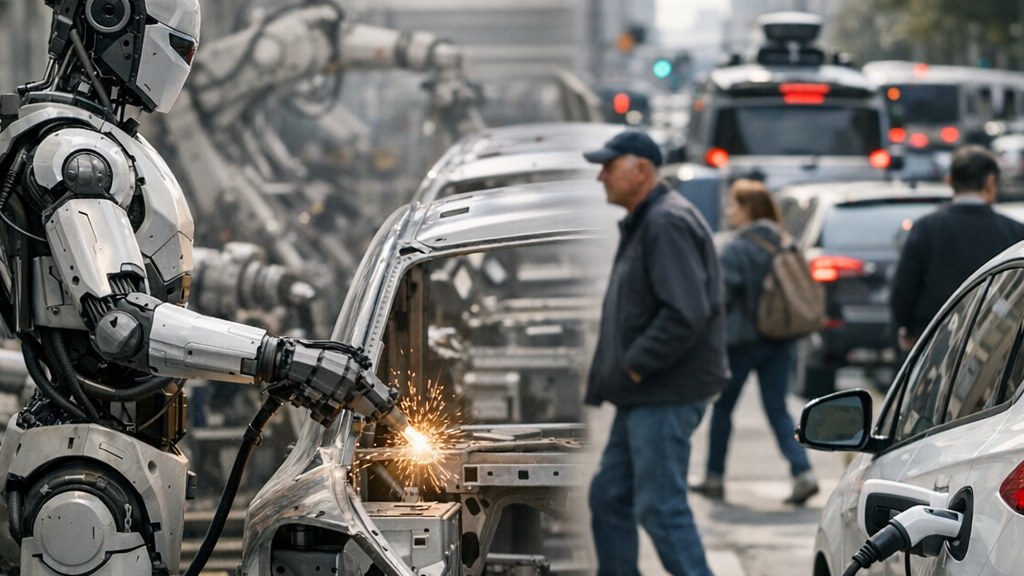
That does not mean every job disappears. It means many tasks change. Workers may need to learn new software, judge AI output, handle more data, or combine technical skills with communication and judgment.
The skills gap is already a central concern for employers. Nearly 40% of skills required on the job are expected to change by 2030, and many employers identify skill shortages as a barrier to transformation. This creates a timing problem. Tools can be released in months. Education systems, training programs, workplace rules, and personal habits often take years to adjust.
## People use the tools but question the pace
Public reaction is mixed. Many people see practical benefits. AI can summarize long documents, help write code, translate text, support medical research, and save time on routine work. Electric cars can lower fuel use and change local air pollution. Digital tools can make services faster and more accessible.
But faster does not always feel better. In late May and early June 2026, 65% of Americans in a national poll said AI was advancing too quickly. An earlier May poll put that share at 71%. Another 2025 survey found that 57% of U.S. adults felt they had little or no control over whether AI was used in their lives, while 61% said they wanted more control.
The gap between use and confidence is important. People may rely on a tool while also distrusting its effects. A student may use AI for homework and worry it weakens learning. A worker may use AI to save time and fear it changes hiring. A voter may use digital platforms for information and still worry about false images, fake audio, or manipulated posts.
## The brain meets a crowded news cycle
The future also feels faster because information about change now moves instantly. A new model, drug trial, battery plant, climate record, court ruling, or space mission can become global news within minutes. Each item competes for attention before the last one is fully understood.
This produces a sense of compression. People are asked to form opinions about technologies while those technologies are still changing. They are asked to plan careers around tools whose limits remain unclear. They are asked to trust systems that may be invisible in daily life.
The result is not simply fear of the future. It is a mismatch between the speed of invention and the slower pace of public understanding, regulation, education, and trust.
The central question is no longer whether the future is coming. It is how societies can slow down enough to understand what should be adopted, what should be limited, and who gets a voice in those choices.
AI Perspective
The pace of change is not only a technology story. It is a human adjustment story. The future may feel more understandable when people have clearer rules, better training, and more control over the tools entering their lives.


-134c72da.webp)


-6c40e5ef.webp)