[[[SUMMARY_START]]]
The workday is stretching across mornings, evenings, weekends and personal time.
Emails, chats and calls have made many workers feel that they must always be ready to answer.
New workplace data links frequent after-hours contact with higher stress and weaker work-life boundaries.
Some countries and employers are now trying to define when workers can switch off.
[[[SUMMARY_END]]]
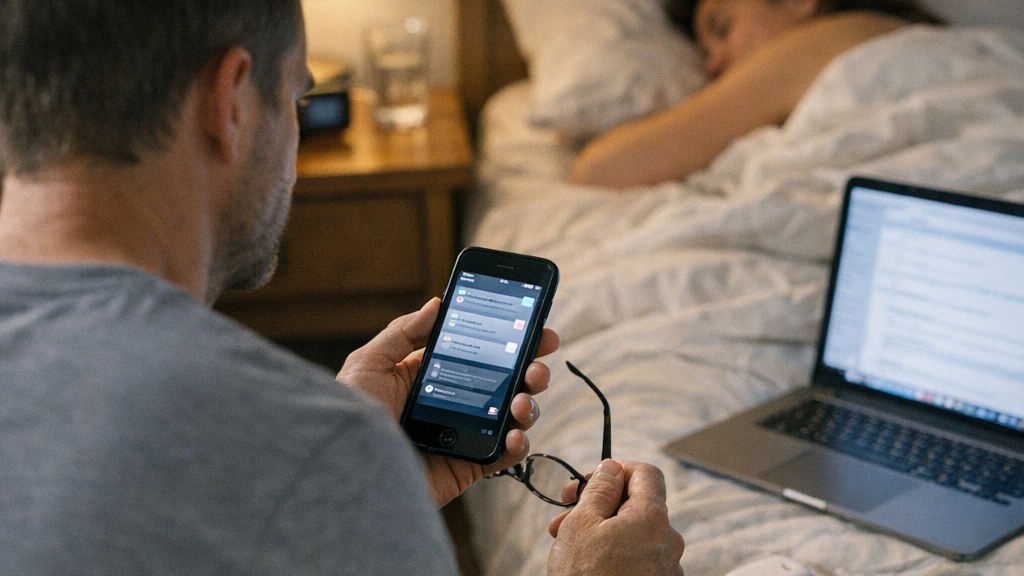
For many workers, the end of the workday no longer feels like a clear stop. A message can arrive during dinner. A manager can call during a commute. A client can send a weekend email that sits unread but still feels urgent.
## Work now follows people homeThe anxiety of being always reachable has become a common feature of modern work. It is not only about long hours. It is about the feeling that work can interrupt any hour.
Smartphones, laptops and workplace chat apps have made it easier to work from anywhere. They have also made it harder to know when work is over. A person may leave the office, close a laptop or end a shift, but still feel the pull of unread messages.
Recent workplace data shows how far the pattern has spread. A 2025 global survey of 31,000 knowledge workers found that nearly half of employees said their work felt chaotic and fragmented. Separate digital workplace data found that many online workers were receiving hundreds of work pings a day, including emails, chats, meeting notices and other alerts.
Evenings are no longer fully protected. Meetings after 8 p.m. rose in the measured workplace data, and many workers sent or received messages outside core business hours. Weekend email use also appeared among workers who were active on Saturdays and Sundays.
## The pressure to answer fast
Researchers often describe this pressure as workplace telepressure. It means a strong urge to respond quickly to work messages, even when a reply is not formally required.
The pressure can come from managers, clients and co-workers. It can also come from the worker’s own fear of falling behind, seeming unavailable or missing an important decision. In some jobs, silence can feel risky, even when the message is not urgent.
The problem is especially visible in roles that depend on coordination across teams and time zones. Managers, consultants, health workers, educators, customer service staff and people in global companies may face repeated contact outside regular hours. Remote and hybrid work can add flexibility, but it can also blur the boundary between home and office.
A 2026 European analysis found that one in five workers in the European Union were contacted for work-related reasons outside working hours several times a month. Among workers contacted daily, 59% said they experienced stress at work always or almost all of the time. Among workers never contacted outside working hours, that figure was 17%.
Some governments have responded with “right to disconnect” rules. France made the issue prominent when its law took effect in 2017, requiring larger companies to address the use of digital tools outside working time.
Australia expanded the debate in 2024 and 2025. Its rules give many employees the right to refuse to monitor, read or respond to contact outside working hours, unless the refusal is unreasonable. The rules do not ban all after-hours contact. They focus on whether the worker should have to respond.
European countries have taken different paths. Some rules apply broadly. Others focus on teleworkers. In some places, employers must avoid contacting workers during rest periods. In others, workers are protected when they do not respond.
These policies show that the issue is no longer treated only as a personal habit. It is also becoming a question of labor standards, mental health and workplace culture.
## Companies face a culture test
Rules alone may not solve the problem. Many workers know that a late message does not always need an answer, but still feel pressure when leaders send messages at night or praise quick replies.
Clearer norms can help. Employers can mark urgent messages clearly, delay non-urgent emails, set team response windows and define who is truly on call. Workers can also benefit when managers model healthy behavior by not expecting instant replies after hours.
The challenge is to keep the useful parts of digital work without allowing work to fill every quiet space. The same tools that support flexibility can also create constant alertness.
The new anxiety of being always reachable is therefore not just a technology problem. It is a boundary problem. As work becomes more digital, the right to rest may depend less on leaving a building and more on whether people are allowed to stop listening for the next ping.
AI Perspective
The central issue is not whether workers should ever answer after hours. Some jobs need urgent contact, and flexibility can help many people. The healthier question is whether constant availability has become the default when it should be the exception.


-134c72da.webp)
