[[[SUMMARY_START]]]
Digital life is still expanding, but many people are also putting new value on nearby places.
Remote work, local shopping, neighborhood news groups and walkable planning are reshaping daily routines.
Recent data shows this return to local life is real, but uneven across income, geography and access.
[[[SUMMARY_END]]]
The world is more connected than ever through phones, platforms and online services. Yet one of the clear social shifts of the past few years is a renewed interest in local life. People are still online, but many are also spending more time near home, using nearby shops, following neighborhood updates and asking cities to make daily needs easier to reach.
## Digital connection has not replaced placeThe return of local life is not a rejection of technology. It is happening inside a hyperconnected world.
In the United States, large shares of adults use major online platforms. Recent survey data shows 84% of adults use YouTube, 71% use Facebook and 50% use Instagram. TikTok, WhatsApp and Reddit have also grown. About half of adults use Facebook daily, and nearly half use YouTube daily.
These networks shape how people learn about the world. They also shape how people learn about their own streets. Local news and information increasingly move through neighborhood groups, community chats, social feeds and online-only sources. In 2024, 52% of U.S. adults said they at least sometimes got local news from online forums such as neighborhood social groups, up from 38% in 2018.
This creates a mixed picture. Digital tools help people find a lost pet, learn about a road closure, support a school fundraiser or discover a nearby event. But they can also spread rumors quickly. Local life is returning with digital tools attached.
## Work has moved closer to home
Remote and hybrid work are among the biggest reasons people are rethinking the role of the neighborhood.
The share of U.S. workers who usually worked from home fell to 13.3% in 2024, down slightly from 13.8% in 2023. But it remained far above the 5.7% recorded in 2019. Labor data for 2025 also showed that 22.4% of people at work teleworked or worked at home for pay for at least some hours.
This has changed daytime life in many communities. A worker who once bought coffee near a downtown office may now visit a cafe near home. Lunch, errands, exercise and child care may happen within a smaller radius. In some places, that shift has helped neighborhood business districts. In others, it has added pressure to city centers that still depend on office crowds.
The trend is not shared equally. Remote work remains more common among higher-income and professional workers. Many service, health, transport, construction and retail jobs still require people to be on site. That means the return of local life looks very different depending on occupation and income.
## Main streets and markets are gaining attention
Local business districts have become a focus for cities and small towns trying to strengthen community life.
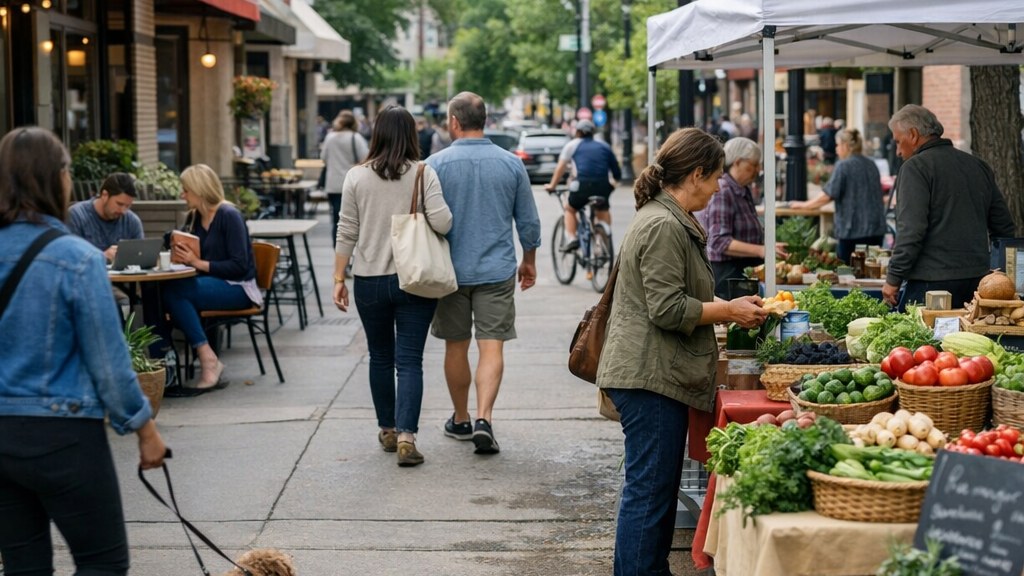
Those figures reflect a wider effort to make commercial corridors more than shopping areas. Many towns are using public events, historic building repairs, outdoor dining, farmers markets, arts programs and small business support to bring people back into shared spaces.
Local food systems are part of the same pattern. Farmers markets, farm stands, food hubs and community-supported agriculture programs connect producers and customers in ways that are both economic and social. People may still order groceries online, but many communities continue to treat food markets as places to meet neighbors, support growers and maintain local identity.
## Cities are planning for proximity
Urban planners are also giving more attention to proximity. The “15-minute city” idea, linked most closely with Paris, aims to make daily needs such as shops, schools, health care, parks and cultural services easier to reach by walking, cycling or public transport.
Paris has expanded cycling routes and invested heavily in bike infrastructure as part of a broader effort to reduce car dominance and strengthen neighborhood access. Other cities have adapted similar ideas in different forms, from local service hubs to mixed-use districts and safer streets.
Research on proximity-based cities finds that access is highly uneven. Dense areas with many services tend to do better. Outer districts and lower-income areas often have fewer nearby options. That makes equity a central issue. A neighborhood cannot become more livable simply by using a slogan. It needs transport, housing, services, safety and public space.
## The neighbor question remains difficult
The return of local life also faces a social challenge: many people do not know their neighbors well.
A 2025 U.S. survey found that 26% of adults said they knew all or most of their neighbors. Another 62% said they knew only some. On trust, 44% said they trusted all or most people in their neighborhood, while 46% trusted some.
Public health experts have warned that loneliness and social isolation are widespread and carry serious effects for well-being. That concern has pushed more attention toward libraries, parks, faith communities, clubs, volunteer groups, schools and local events as part of the social infrastructure of everyday life.
The new local life is therefore practical, not nostalgic. It is about where people work, shop, walk, learn, care and gather. Technology has made the world feel smaller. At the same time, it has reminded many people that the most important parts of daily life still happen close to home.
AI Perspective
The strongest communities may be the ones that combine digital reach with real local ties. Online tools can help people organize, but trust usually grows through repeated contact in shared places. The main lesson is simple: connection works best when it is both global and close to home.


