Traditional work models lose ground as countries settle into a more flexible era

[[[SUMMARY_START]]]

Standard office hours and fixed workplaces are giving way to hybrid schedules, remote work and other flexible arrangements in many countries.
The shift is uneven, with knowledge-based jobs changing faster than factory, retail and care work.
Governments and employers are now focusing less on whether flexibility exists and more on how to manage it fairly and productively.

[[[SUMMARY_END]]]

The traditional model of work — a fixed schedule in a central office or workplace, five days a week — is weakening across many countries. It has not disappeared, and in large parts of the economy it still dominates. But in professional and public-sector jobs especially, the old pattern is no longer the default it once was.

The change began sharply during the pandemic, but its lasting impact is now clearer. In many economies, remote work did not fade away once health restrictions ended. Instead, it settled into a more stable hybrid form, with workers splitting time between home and the workplace.

In Europe, this pattern is especially visible in countries with strong digital infrastructure and a large share of service-sector jobs. The Netherlands remains one of the clearest examples, with more than half of workers having at least some teleworking hours in recent labour data. Across the European Union, working from home at least occasionally is now far more common than it was before 2020.

At the same time, fully remote jobs appear to have pulled back from their pandemic peak. Hybrid work has become the compromise many employers prefer. It offers some flexibility to workers while preserving regular in-person meetings, team routines and office use.

## Hybrid becomes the new center

This does not mean a single global model has replaced the old one. Countries are moving at different speeds, and not all sectors can adapt in the same way. Office-based finance, technology, consulting and administrative work have changed much faster than construction, transport, hospitality or healthcare.

That gap matters. The decline of traditional work models is strongest in jobs that can be done with a laptop, stable internet access and digital tools. For millions of other workers, the workplace is still physical and fixed. This has created a growing divide between workers with more control over where and when they work and those with far less.

Public policy is also shifting. In Britain, legal changes that took effect in April 2024 strengthened the process for requesting flexible working from the first day of employment. Similar debates are appearing elsewhere as governments try to balance labour shortages, family life, productivity and equal treatment.

The broader direction is clear in employer surveys as well. Global business leaders increasingly describe workforce flexibility as part of long-term strategy rather than a temporary response. Alongside digitalization and automation, flexible work has become one of the tools companies use to attract staff and retain skills.

## Pressure from workers and employers
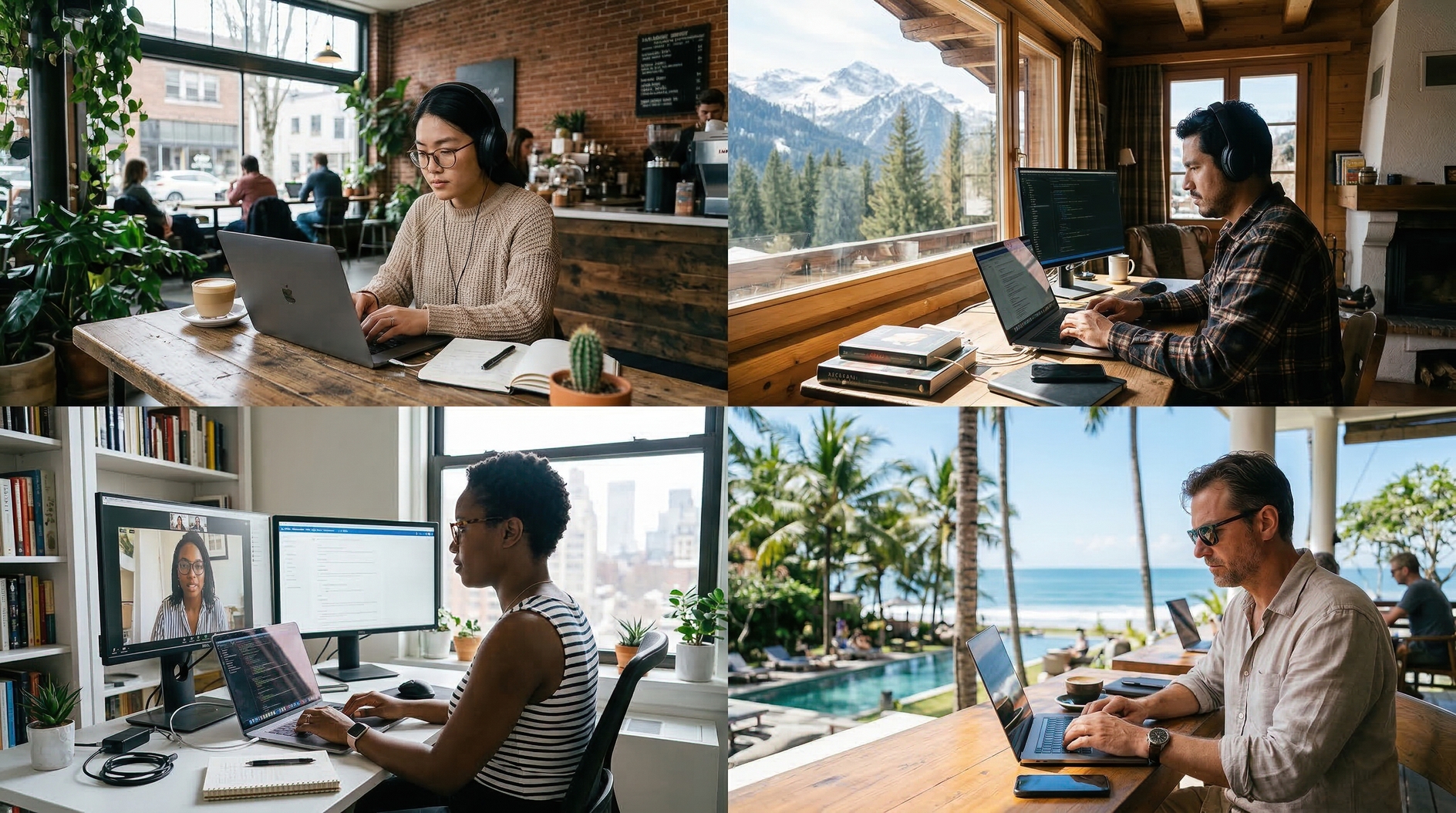
Remote workers using laptops across diverse global settings including cafe, mountain cabin, office,
Even so, the transition is not smooth. Some employers have pushed staff back to offices more often, especially in 2025 and early 2026. In parts of North America, return-to-office policies have tightened in both business and government. That has shown that the decline of traditional work is real, but not linear.

Many workers still say they value flexibility highly, particularly parents, caregivers and people facing long commutes. Researchers and labour institutions have repeatedly linked flexible work, when well managed, to better work-life balance and in some cases stronger retention. But the same institutions also warn that remote work can bring risks, including isolation, blurred working hours and unequal access to promotion.

Working time itself is also under review. International labour research has pointed to long-standing problems at both ends of the scale: overwork for some, insecure or shortened hours for others. That has helped widen interest in compressed schedules, four-day week trials, job sharing and stronger rules around disconnecting from work messages outside working hours.

These experiments are still limited compared with the size of the global workforce. Yet they show that the debate is now broader than remote work alone. The deeper change is a challenge to the old assumption that work must happen in one place, on one timetable, under one uniform model.

## A cultural shift, not just a workplace one

This makes the story larger than management policy. It is a cultural change in how time, productivity and daily life are understood. In many households, work is now arranged around school runs, elder care, housing costs and commuting burdens in ways that would have seemed unusual just a few years ago.

Technology is a major force behind this shift, but not the only one. Ageing populations, tighter labour markets in some sectors, and changing expectations among younger workers are also pushing employers to rethink older structures. At the same time, artificial intelligence and digital monitoring tools are raising new questions about how work is supervised, measured and shared.

Traditional work models are therefore not simply collapsing. In many countries they are being narrowed, adapted or combined with newer systems. The result is a more mixed world of work: less uniform, more flexible, and in some cases more unequal.

What comes next will depend on policy, management choices and the bargaining power of workers. But across countries, the direction is already visible. The standard work model that shaped much of the last century is no longer the only model that serious employers, workers and governments expect to last.

AI Perspective

The biggest shift is not simply where people work, but how societies define a normal working life. Flexibility is becoming a lasting expectation in many places, even as access to it remains uneven. The next challenge will be making newer work models fairer across different kinds of jobs.

Doing Nothing, on Purpose: Why Rest Is Becoming a Quiet Cultural Skill

[[[SUMMARY_START]]]

In a culture that rewards constant output, doing nothing is gaining new value. Researchers and health experts say rest, unstructured time, and even boredom can support well-being, attention, and creativity. The shift is also shaping debates about work hours, burnout, and what a balanced life should look like.

[[[SUMMARY_END]]]

For years, modern life has treated busyness as a sign of virtue. Full calendars, side projects, and the pressure to stay reachable have made idleness look wasteful. But a quieter countercurrent is growing: the idea that doing nothing, at least sometimes, is not failure. It is a human need.

The change is showing up across work, wellness, and everyday culture. People are talking more openly about burnout. Employers are testing shorter workweeks. Therapists and health specialists are warning about the emotional cost of constant striving. And researchers are taking a closer look at boredom, mind wandering, and the value of mental downtime.

## A backlash against constant output

The modern productivity ideal promises control, efficiency, and self-improvement. Yet for many people, it has also brought guilt around rest. Even time off can feel like a task to optimize.

Health experts increasingly describe this pattern as harmful when it becomes extreme. The problem is not ambition itself. It is the feeling that every hour must be useful, measurable, or marketable. When people cannot switch off, stress can build, sleep can suffer, and rest may stop feeling restorative.

That tension helps explain why “doing nothing” has moved from a joke or luxury into a serious cultural conversation. In some circles, it is framed as resistance to hustle culture. In others, it is simply basic self-preservation.

## What boredom and rest can do

Researchers draw an important distinction between chronic, distressing boredom and short periods of unstructured mental space. Long-term boredom can be linked to poorer well-being and rumination. But brief pauses, quiet breaks, and looser attention may do something different.

Recent work on creativity suggests that mind wandering during breaks can help later performance on creative tasks. Other studies indicate that boredom at work is not always purely negative. In some cases, it may push people toward meaningful leisure activities, which can in turn support creativity.

This does not mean every blank hour becomes a breakthrough. It means the mind may benefit from time that is not tightly managed. Ideas often arrive when attention softens: during a walk, while staring out a window, or in the pause after focused effort.

Older neuroscience and psychology research has long suggested that the brain remains highly active during rest. That background activity appears to play a role in reflection, memory, and internal thought. Newer studies are adding to the case that nonstop stimulation may crowd out some of these processes.

## Why the message matters now

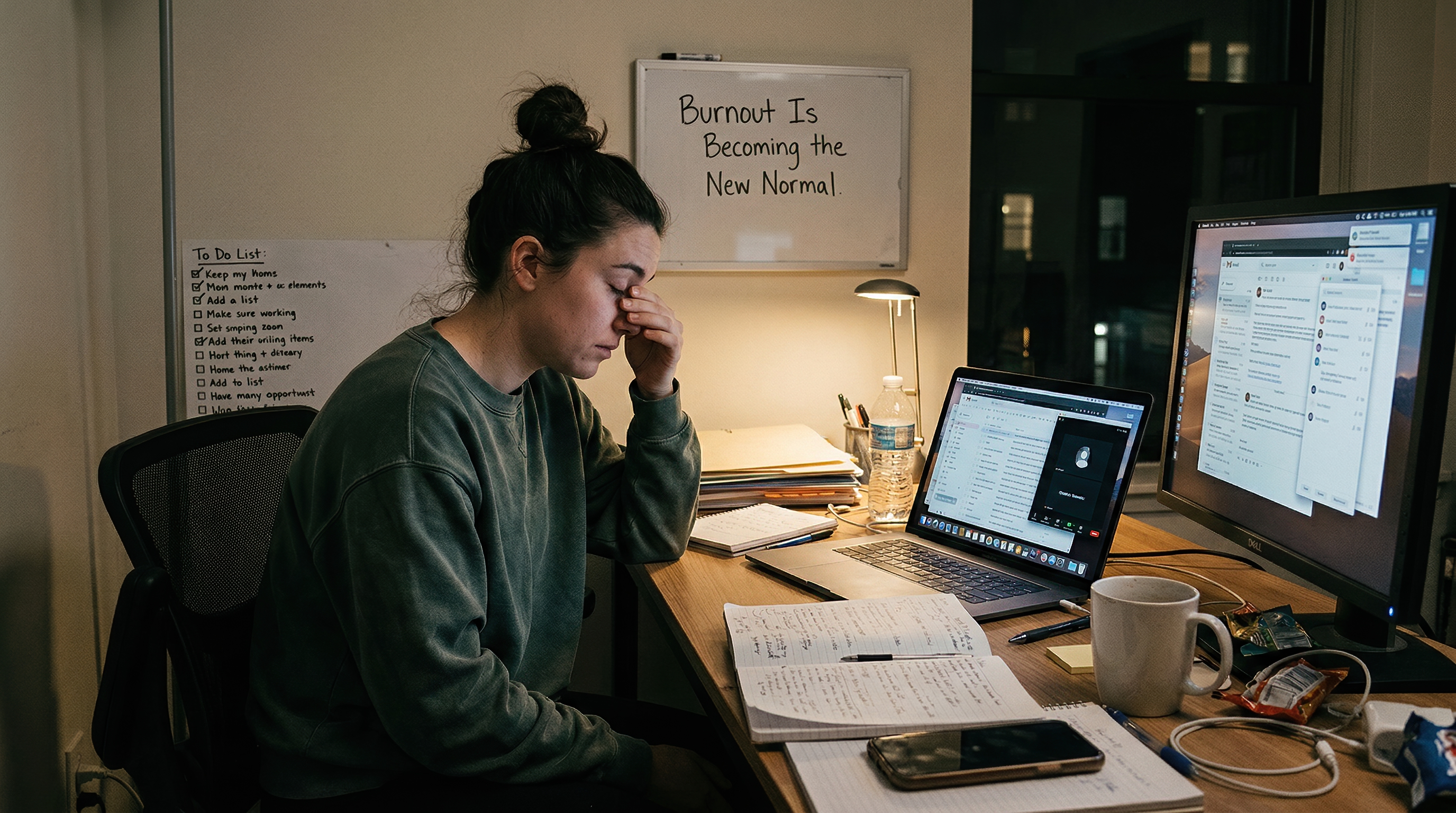
Stressed remote worker feeling burnout while working late night at home office desk
The debate over doing nothing is landing at a moment when many people feel digitally overloaded. Online life keeps work, news, messages, and entertainment in constant reach. That can leave little room for silence or boredom of any kind.

Some recent psychological research points to rising concern about boredom in the digital age, even as screens provide endless distraction. The paradox is simple: people may feel overstimulated and under-rested at the same time.

Work culture is changing too. A major 2025 study of four-day workweek trials across 141 organizations and 2,896 employees in several countries found improvements in burnout, job satisfaction, mental health, and physical health when hours were reduced without cutting pay. The study focused on workplace reform, not idleness as a philosophy. Still, it added weight to a broader idea: more time is not always better work.

That finding fits a wider cultural reassessment. The question is no longer only how to get more done. It is also how much pressure a person can absorb before productivity starts to damage the life it is supposed to support.

## From luxury to life skill

For some people, doing nothing remains a privilege. Many workers have limited control over their hours, multiple jobs, caregiving duties, or financial pressure that makes rest hard to protect. Any cultural celebration of idleness can sound hollow if it ignores that reality.

Still, the appeal of intentional rest is broad because it speaks to a common experience. People are tired of feeling late to their own lives. They want room to think, to drift, to recover, and to be present without turning every moment into output.

That does not require a grand retreat from modern life. In practice, it may look small and ordinary: leaving the phone behind for a short walk, sitting without filling the silence, protecting an afternoon without goals, or letting a commute remain empty instead of packed with content.

The art of doing nothing is not really about doing nothing forever. It is about making peace with moments that do not produce proof. In a world obsessed with visible productivity, that can be harder than it sounds.

And that may be why the idea resonates now. Rest is no longer just recovery from work. Increasingly, it is being treated as part of a meaningful life, and perhaps as one of the few spaces where attention, creativity, and calm still have room to return.

AI Perspective

This topic reflects a wider shift in how people define a good life. Productivity still matters, but many now seem to be asking whether constant efficiency is worth the personal cost. The renewed respect for rest suggests that time without output may be less a waste than a form of balance.

The Case for Simple Eating Grows as Modern Diet Trends Shift

[[[SUMMARY_START]]]

Nutrition guidance is moving back toward familiar basics. Recent evidence and public health advice increasingly point to meals built from vegetables, fruit, beans, whole grains, nuts, dairy, seafood, and other minimally processed foods. The shift reflects growing concern about diets heavy in ultra-processed products, which remain a major part of daily eating in the United States.

[[[SUMMARY_END]]]

For years, modern diet culture has moved in cycles. One season favors cutting carbs. Another focuses on protein, fasting, supplements, or highly engineered “healthy” snacks. But across medical guidance and nutrition research, one message has become clearer: simple eating still holds up.

That does not mean a strict or old-fashioned diet. It means building meals from recognizable foods, cooking more often when possible, and relying less on heavily processed products. In 2026, that advice looks less like a trend and more like a steady center point in a crowded food market.

Nutrition advice has changed in style over time, but its core has stayed fairly stable. Healthy eating patterns are still built around vegetables, fruit, whole grains, beans, nuts, seeds, and balanced sources of protein and dairy or fortified alternatives. Public health guidance in the United States now continues to stress those basics, with fresh attention on foods that are heavily processed and easy to overconsume.

## Why simple eating keeps returning

Simple eating appeals for a practical reason: it is easier to understand than a rule-heavy diet. A meal based on oatmeal, yogurt, fruit, beans, rice, eggs, fish, salad, soup, or roasted vegetables needs little interpretation. It often brings fiber, vitamins, minerals, and a better balance of energy than packaged foods built around refined starches, added sugars, salt, and industrial formulations.

Recent federal guidance has also moved toward a food-first message. The broad idea is not to chase a perfect menu or ban entire food groups. It is to make routine meals more nutrient-dense and less dependent on products marketed as convenient wellness solutions.

That approach also fits with the way many dietitians now speak to the public. Instead of asking people to count every gram, they often focus on repeating a few reliable habits: eat more plants, choose whole grains more often, include protein with meals, and cut back on sugary drinks and highly processed snacks.

## The pressure from ultra-processed foods

One reason this shift matters is that ultra-processed foods still make up a large share of everyday eating, especially in the United States. These foods can include sweetened drinks, packaged desserts, chips, instant meals, fast-food combinations, and many snack products designed for long shelf life and intense flavor.

Research published in recent years has linked higher intake of ultra-processed foods with worse health outcomes across several areas, including cardiovascular disease and type 2 diabetes risk. Some reviews note that the evidence does not mean every processed item is equally harmful, and researchers are still debating which part of the problem matters most: the processing itself, the nutrient profile, how the foods are marketed, or how easily they displace healthier meals. Even so, the overall direction of the evidence has pushed health authorities to pay closer attention.

The concern is not only what these foods contain. It is also what they replace. When packaged snacks and ready-to-eat meals take the place of beans, vegetables, fruit, or whole grains, diet quality tends to drop. Over time, that can shape weight, blood sugar, heart health, and daily energy.

Fresh berry and walnut salad on rustic wooden table in sunny outdoor garden setting
## Not all “healthy” diets are equally simple

Many popular diets borrow from the same healthy principles, but they often become confusing in practice. Mediterranean-style eating remains widely respected because it is flexible and food-based. It centers on vegetables, legumes, grains, olive oil, nuts, and fish, with room for local variation. It does not depend on powders, bars, or strict timing rules.

By contrast, some modern diets are built around labels rather than foods. A product may be sold as high-protein, low-carb, keto-friendly, plant-based, or functional, yet still be heavily processed. That does not automatically make it unhealthy, but it can make people think they are eating simply when they are actually buying a more complicated version of the same snack culture.

This is one reason the plainest advice often travels best: an apple is easier to evaluate than an apple-flavored performance product. Lentils are easier to understand than a shelf-stable meal replacement with a long ingredient list.

## What smart eating looks like now

For most people, eating simply does not require a full lifestyle overhaul. It can start with a few steady changes: choosing water more often than sweet drinks, eating fruit instead of dessert some days, cooking a basic dinner at home, or making lunch from leftovers instead of packaged convenience foods.

Simple eating also leaves room for real life. Frozen vegetables, canned beans, plain yogurt, peanut butter, whole-grain bread, and tinned fish can all support a strong diet. The goal is not perfection or culinary purity. It is a pattern that is easier to sustain over months and years.

Cost and access still matter. Fresh food is not equally available everywhere, and time for cooking is not evenly shared. That is one reason nutrition experts increasingly talk about realistic swaps rather than idealized diets. A simpler diet works best when it is affordable, familiar, and repeatable.

In that sense, the truth about modern diets may be less dramatic than the marketing around them. After years of competing promises, the smartest choice today may be the least flashy one: eat food that looks like food, keep most meals straightforward, and let consistency do more of the work.

AI Perspective

Food advice often becomes noisy when it is turned into a trend. The stronger long-term message is much quieter: diets built from familiar, minimally processed foods are easier to follow and easier to trust. In a crowded wellness market, simplicity may be one of the most useful forms of nutrition guidance.

The Traditional 9-to-5 Is Fading. A More Flexible, More Fragmented Work Life Is Taking Its Place

[[[SUMMARY_START]]]

The classic full-time office job still exists, but it no longer defines work for many people. Hybrid schedules, remote roles, contract work and app-based gigs are reshaping how jobs are organized.

Recent labor and workplace data suggest the shift is stabilizing rather than reversing. The result is not the end of work, but a move toward careers built across more places, more schedules and, for some, more than one income stream.

[[[SUMMARY_END]]]

The old picture of work was simple. A person commuted to one workplace, stayed for fixed hours, and built a career inside a single company.

That model still matters, but it no longer fits a large share of working life. In the United States and many other countries, the standard 9-to-5 job has given way to something looser: hybrid schedules, fully remote roles, project work, side gigs, and jobs shaped by software and automation as much as by office routines.

For millions of workers, the biggest change is not that offices disappeared. It is that the workweek became negotiable.

Recent workplace surveys show remote work has settled into a durable middle ground rather than vanishing. Many workers in jobs that can be done from home now split time between home and office. Research in early 2025 found full-time employees were, on average, working from home for roughly a quarter of paid workdays, while global surveys showed work from home had eased from pandemic highs but then stabilized.

That means the five-day office week is no longer the default for a large part of the professional economy. Hybrid work has become a normal arrangement in fields such as technology, finance, marketing, design and administration.

## Flexibility becomes part of the job

The appeal is clear. Workers often say flexibility helps them manage commuting, caregiving, health, and personal time. In a 2024 survey released in 2025, the Federal Reserve found many people doing short-term app- or web-based tasks valued gig work because it let them work flexible hours.

The same pressure is changing regular employment. Workers increasingly judge jobs not only by salary, but by schedule control, commute burden and whether the role can fit around family life. Research released in 2025 also found strong interest in hybrid and remote options even as some employers pushed staff back into offices more often.

But flexibility does not mean full freedom for everyone. Many jobs in health care, retail, manufacturing, transport, hospitality and public services still require people to be on site. The new work divide is often less about age or preference than about occupation. Some workers can bargain over where they work. Others cannot.

## Growth in contract and gig work

Another shift is the spread of work outside the classic payroll model. Government data released in late 2024 showed 4.3% of U.S. workers held contingent jobs in July 2023, equal to about 6.9 million people. The same data showed 7.4% were independent contractors in their main job.

Those numbers do not capture the full picture of modern side work. The Federal Reserve reported that in 2024, 9% of U.S. adults earned money from gig activities such as short-term tasks, while a smaller share used apps or websites to find that work. For many, this was not a primary job but a supplement to wages that no longer stretched far enough.

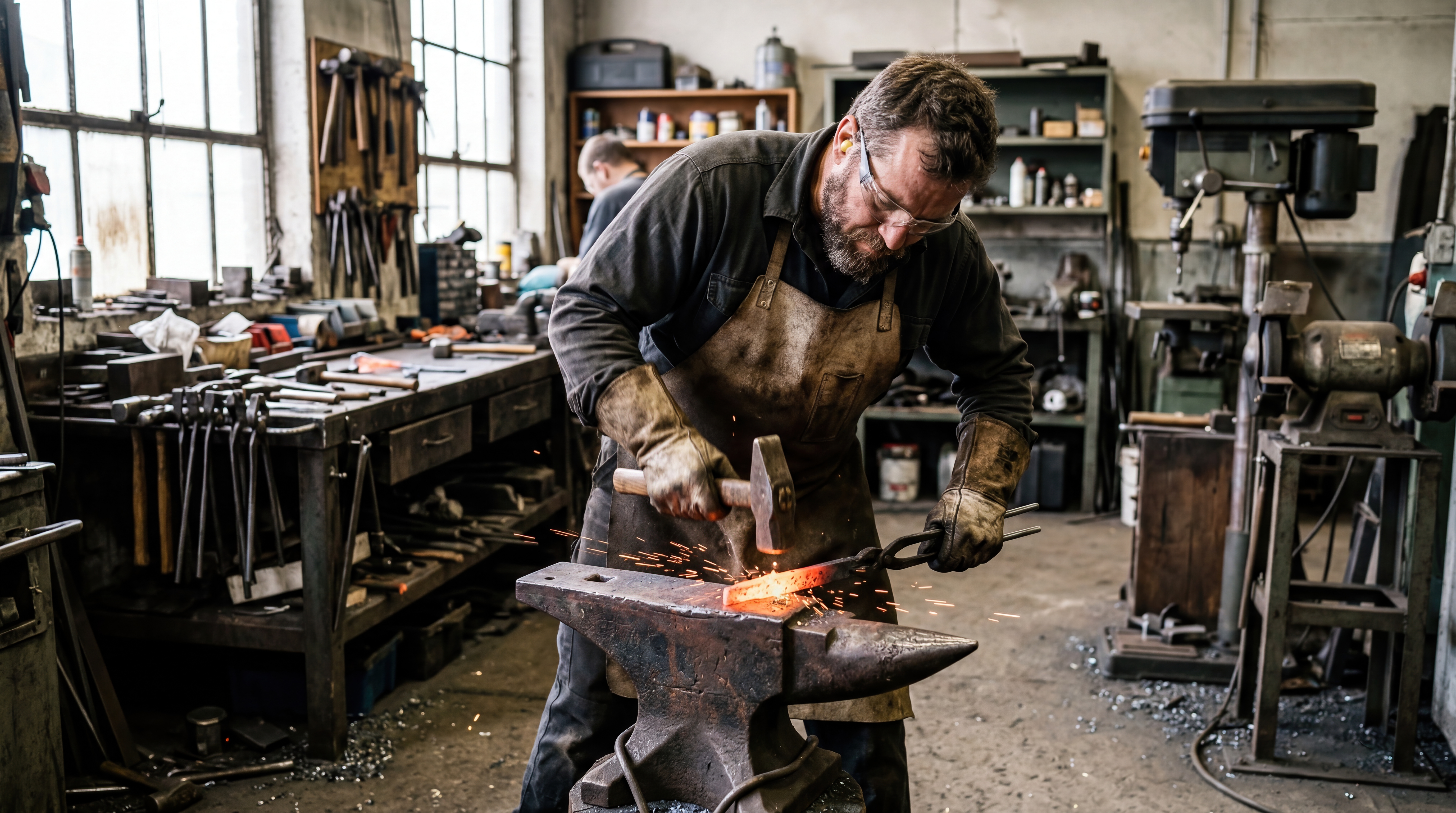
Skilled blacksmith forging glowing metal on anvil in traditional workshop interior
This is one reason the old 9-to-5 is fading culturally as well as economically. Work is no longer always one job, one employer, one identity. It may be a salary plus freelance projects, part-time consulting, online selling, or driving and delivery shifts fitted around another schedule.

## AI changes tasks before it eliminates jobs

Artificial intelligence adds another layer to the transition. So far, the clearest effect is not a sudden collapse in employment, but a steady redesign of tasks.

Global employer surveys published in 2025 found companies expected significant job disruption by 2030, with both job creation and job displacement rising at the same time. Fast-growing roles are concentrated in data, AI, software and digital systems, but demand is also expected to grow in fields rooted in care, education, logistics and the wider physical economy.

That points to a future in which fewer careers are defined by a fixed daily routine alone. Workers may need to update skills more often, move between employers more easily, and combine technical tools with human strengths such as judgment, communication and care.

## What comes after the 9-to-5

What comes next is not one clean replacement. It is a patchwork.

For some people, that means hybrid work with two or three days at home. For others, it means freelancing between contracts. For younger workers entering the labor market, it may mean a career path that is less linear and less tied to a single company. And for many lower-paid workers, it may mean an uneasy mix of flexibility and insecurity.

The traditional job is not dead. It remains central in vast parts of the economy. But it is no longer the only model people organize their lives around, and it no longer holds the same cultural authority.

The next era of work looks less like a single schedule and more like a set of arrangements. Some offer autonomy. Some shift risk from employer to worker. Most combine both.

AI Perspective

The change in work seems deeper than a debate about office attendance. It reflects a broader shift in how people value time, security and control. The challenge now is to build a work culture that keeps flexibility without making workers carry all the uncertainty alone.

Artemis II lifts off, opening a new chapter in crewed moon flight

[[[SUMMARY_START]]]

NASA’s Artemis II mission has launched from Florida, sending four astronauts on a 10-day trip around the Moon and back.
The flight is the first crewed mission of the Artemis program and the first human lunar voyage in more than 50 years.
The crew includes three NASA astronauts and one Canadian astronaut, reflecting the mission’s international role.
The test flight is designed to prove the rocket, spacecraft, and operations needed for later missions deeper into lunar exploration.

[[[SUMMARY_END]]]

Artemis II has begun with a successful launch from Kennedy Space Center in Florida, starting NASA’s first crewed journey around the Moon since the Apollo era. The mission sent four astronauts into space aboard the Space Launch System rocket and Orion spacecraft on April 1, 2026. It is a major test flight for the systems that NASA plans to use in future lunar missions.

The launch marks a major milestone for human spaceflight. Artemis II is the first time astronauts have flown on NASA’s Space Launch System, or SLS, and the first crewed flight of the Orion spacecraft. NASA describes the mission as a key step toward returning humans to the Moon on a sustained basis and preparing for later missions beyond low Earth orbit.

The four-person crew is led by commander Reid Wiseman and pilot Victor Glover. Mission specialists are Christina Koch and Jeremy Hansen of the Canadian Space Agency. Their flight around the Moon and back is expected to last about 10 days.

The mission lifted off from Launch Complex 39B at Kennedy Space Center during an evening launch window on April 1. The launch came after final rollout, pad work, and crew quarantine in late March. NASA had targeted early April launch opportunities after earlier scheduling changes tied to technical work and readiness checks.

## A crew with several firsts

The flight stands out not only because it returns astronauts to lunar-distance travel, but also because of who is on board. Victor Glover is the first Black astronaut assigned to a lunar mission. Christina Koch is the first woman to fly on a mission around the Moon. Jeremy Hansen is the first Canadian set to travel to the Moon.

That mix gives Artemis II symbolic weight as well as technical value. Unlike the Apollo missions, which were carried out by all-male American crews, Artemis II reflects a broader international and generational shift in human space exploration.

The mission is not intended to land on the Moon. Instead, it is a high-stakes test of the spacecraft, rocket, ground systems, and crew operations during a deep-space voyage. Engineers and mission planners want to confirm that Orion can support astronauts safely beyond Earth orbit and bring them home after the trip.

## What the mission will test

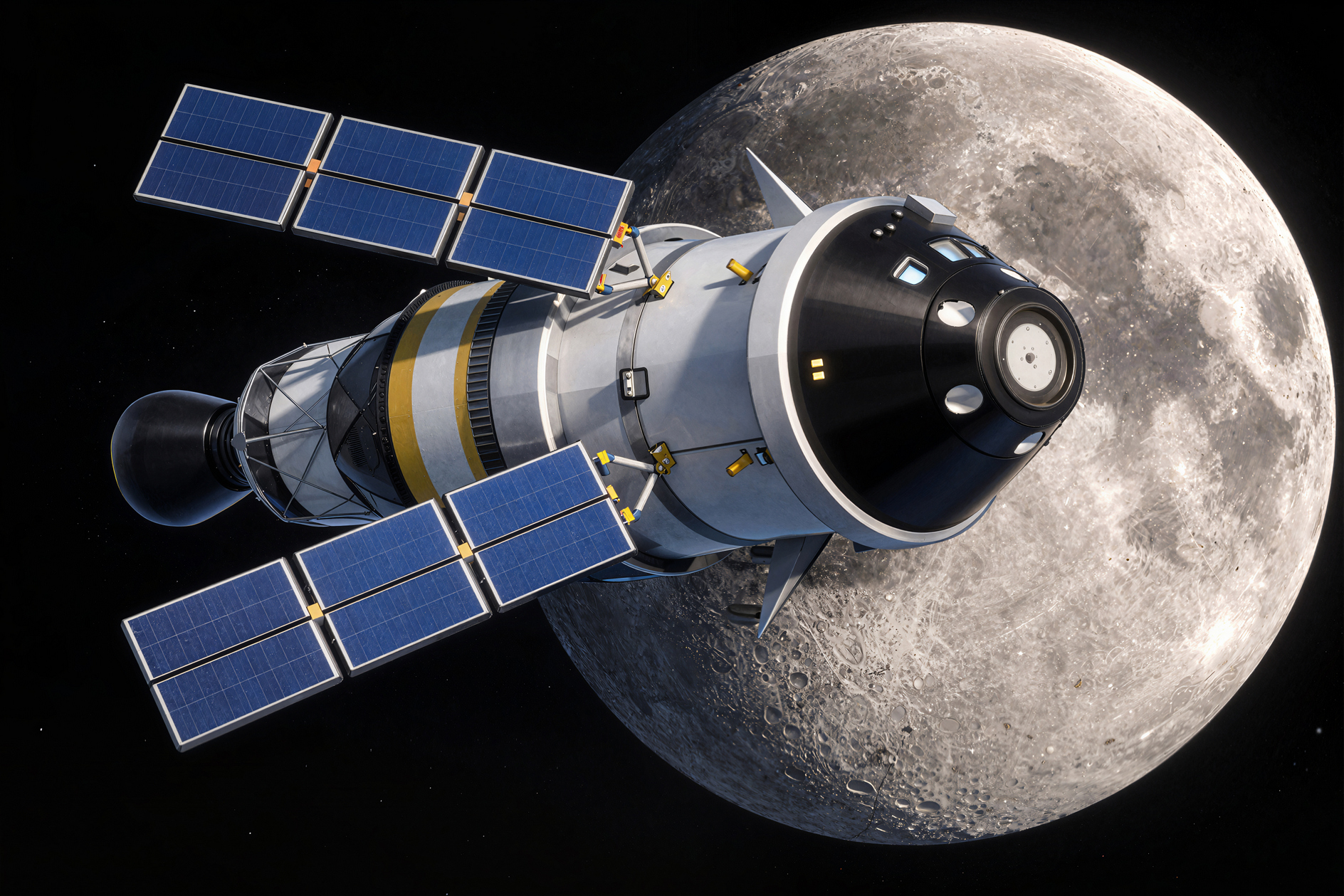
Modern spacecraft orbiting the Moon with solar panels illuminated by sunlight in deep space
During the mission, the crew will evaluate how Orion performs with humans aboard in deep space. That includes life-support systems, navigation, communications, and other operations needed for future lunar flights. The spacecraft and rocket will also be watched closely for how they perform under real mission conditions.

NASA has said Artemis II builds directly on Artemis I, the uncrewed test flight that sent Orion around the Moon in 2022. That earlier mission demonstrated that the spacecraft could make the journey without astronauts. Artemis II now adds the human element, which is essential before later missions attempt more ambitious goals.

The mission also carries scientific and operational value. NASA has said the crew will work with teams on the ground to support investigations linked to human health and deep-space travel. These lessons are expected to help shape later missions to the Moon and, over the longer term, Mars.

## Part of a larger lunar program

Artemis II is one mission inside a broader effort to rebuild regular human exploration beyond Earth orbit. The Artemis program aims to develop a long-term presence at and around the Moon, using new spacecraft, new landing systems, and international partnerships.

In recent planning updates, NASA adjusted the order and design of some future Artemis missions. Even so, Artemis II remains the first major crewed test of the system and an important proof point for the wider program. Its success matters not only for the next flight, but for the credibility of the larger strategy.

Public interest has been strong around the launch. Large crowds gathered along Florida’s Space Coast to watch the rocket rise from the same general area used for Apollo-era lunar missions. The moment connected a new generation of astronauts and engineers with a legacy that has shaped spaceflight for decades.

For now, the focus is on the crew’s trip around the Moon and safe return to Earth. If the mission goes as planned, Artemis II will stand as the clearest sign yet that human lunar exploration has entered a new phase.

AI Perspective

Artemis II matters because it turns years of planning and testing into a real human mission beyond Earth orbit. It also shows how space exploration now blends national ambition with international partnership. If the flight performs well, it could give the Moon a more regular place in human spaceflight again.