[[[SUMMARY_START]]]
Standard office hours and fixed workplaces are giving way to hybrid schedules, remote work and other flexible arrangements in many countries.
The shift is uneven, with knowledge-based jobs changing faster than factory, retail and care work.
Governments and employers are now focusing less on whether flexibility exists and more on how to manage it fairly and productively.
[[[SUMMARY_END]]]
The traditional model of work — a fixed schedule in a central office or workplace, five days a week — is weakening across many countries. It has not disappeared, and in large parts of the economy it still dominates. But in professional and public-sector jobs especially, the old pattern is no longer the default it once was.
The change began sharply during the pandemic, but its lasting impact is now clearer. In many economies, remote work did not fade away once health restrictions ended. Instead, it settled into a more stable hybrid form, with workers splitting time between home and the workplace.In Europe, this pattern is especially visible in countries with strong digital infrastructure and a large share of service-sector jobs. The Netherlands remains one of the clearest examples, with more than half of workers having at least some teleworking hours in recent labour data. Across the European Union, working from home at least occasionally is now far more common than it was before 2020.
At the same time, fully remote jobs appear to have pulled back from their pandemic peak. Hybrid work has become the compromise many employers prefer. It offers some flexibility to workers while preserving regular in-person meetings, team routines and office use.
## Hybrid becomes the new center
This does not mean a single global model has replaced the old one. Countries are moving at different speeds, and not all sectors can adapt in the same way. Office-based finance, technology, consulting and administrative work have changed much faster than construction, transport, hospitality or healthcare.
That gap matters. The decline of traditional work models is strongest in jobs that can be done with a laptop, stable internet access and digital tools. For millions of other workers, the workplace is still physical and fixed. This has created a growing divide between workers with more control over where and when they work and those with far less.
Public policy is also shifting. In Britain, legal changes that took effect in April 2024 strengthened the process for requesting flexible working from the first day of employment. Similar debates are appearing elsewhere as governments try to balance labour shortages, family life, productivity and equal treatment.
The broader direction is clear in employer surveys as well. Global business leaders increasingly describe workforce flexibility as part of long-term strategy rather than a temporary response. Alongside digitalization and automation, flexible work has become one of the tools companies use to attract staff and retain skills.
## Pressure from workers and employers
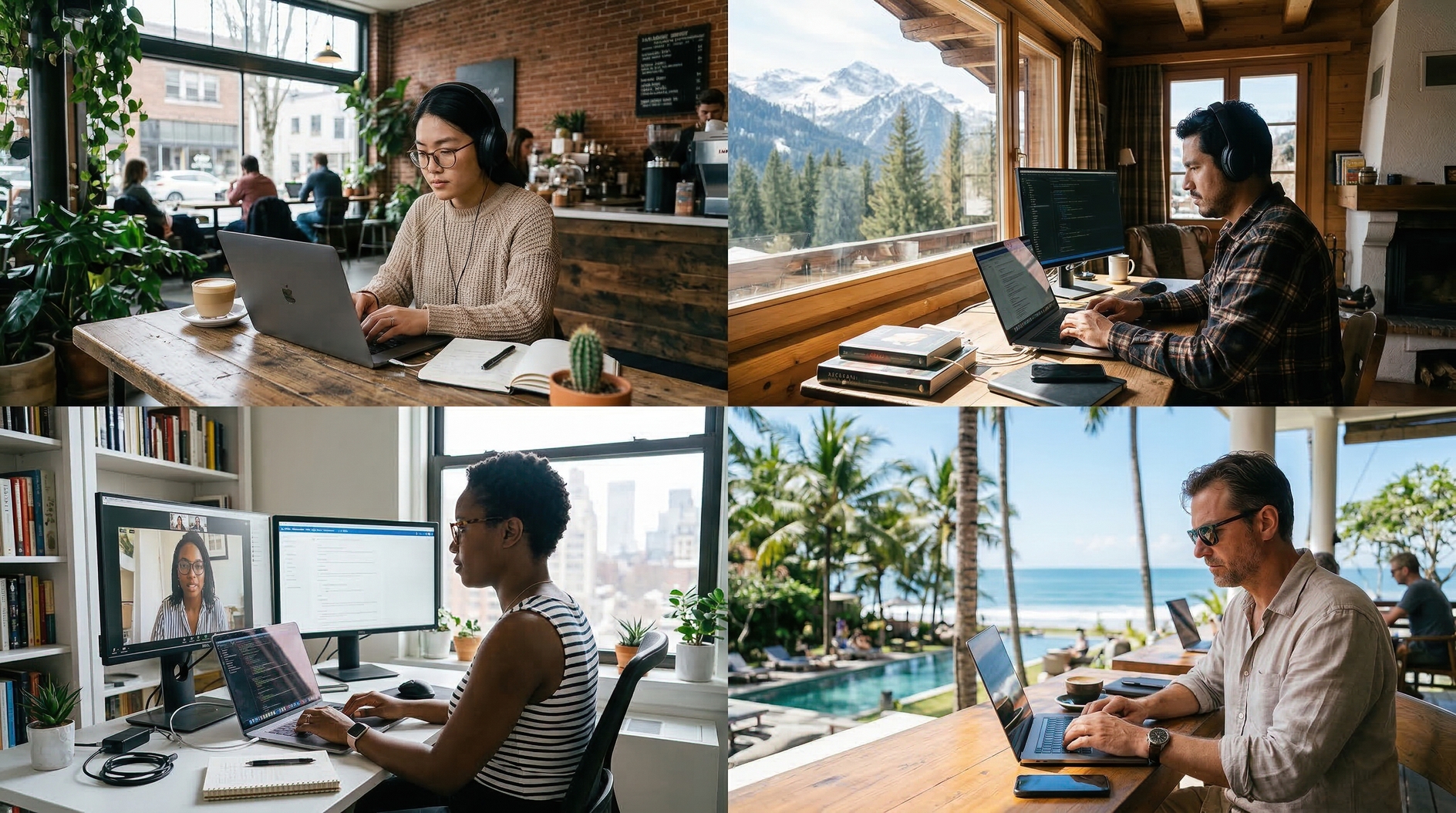
Many workers still say they value flexibility highly, particularly parents, caregivers and people facing long commutes. Researchers and labour institutions have repeatedly linked flexible work, when well managed, to better work-life balance and in some cases stronger retention. But the same institutions also warn that remote work can bring risks, including isolation, blurred working hours and unequal access to promotion.
Working time itself is also under review. International labour research has pointed to long-standing problems at both ends of the scale: overwork for some, insecure or shortened hours for others. That has helped widen interest in compressed schedules, four-day week trials, job sharing and stronger rules around disconnecting from work messages outside working hours.
These experiments are still limited compared with the size of the global workforce. Yet they show that the debate is now broader than remote work alone. The deeper change is a challenge to the old assumption that work must happen in one place, on one timetable, under one uniform model.
## A cultural shift, not just a workplace one
This makes the story larger than management policy. It is a cultural change in how time, productivity and daily life are understood. In many households, work is now arranged around school runs, elder care, housing costs and commuting burdens in ways that would have seemed unusual just a few years ago.
Technology is a major force behind this shift, but not the only one. Ageing populations, tighter labour markets in some sectors, and changing expectations among younger workers are also pushing employers to rethink older structures. At the same time, artificial intelligence and digital monitoring tools are raising new questions about how work is supervised, measured and shared.
Traditional work models are therefore not simply collapsing. In many countries they are being narrowed, adapted or combined with newer systems. The result is a more mixed world of work: less uniform, more flexible, and in some cases more unequal.
What comes next will depend on policy, management choices and the bargaining power of workers. But across countries, the direction is already visible. The standard work model that shaped much of the last century is no longer the only model that serious employers, workers and governments expect to last.
AI Perspective
The biggest shift is not simply where people work, but how societies define a normal working life. Flexibility is becoming a lasting expectation in many places, even as access to it remains uneven. The next challenge will be making newer work models fairer across different kinds of jobs.


-134c72da.webp)


-6c40e5ef.webp)