[[[SUMMARY_START]]]
Climate pressure, water stress and land degradation are reshaping how the world grows and buys food.
Recent global assessments show hunger is still high, even as some regions have improved.
Scientists and farmers are responding with heat-tolerant crops, better water use, early warnings and new production methods.
[[[SUMMARY_END]]]
The future of food is no longer only a question of bigger harvests. It is becoming a race to grow enough nutritious food in a hotter, drier and more uncertain world, while using less land, water and energy.
## Climate is changing the farm calendarRising heat is now one of the clearest threats to agriculture. A joint food and weather assessment released in April 2026 found that extreme heat is putting pressure on crops, livestock, fisheries, forests and the people who work in them.
The risks are already visible. Heat can reduce crop yields, dry pastures, weaken animals and make outdoor farm work dangerous. Marine heatwaves can also damage fisheries and aquaculture. In Brazil, prolonged heat and drought in 2023 and 2024 cut soybean yields by as much as 20 percent in affected areas. In North America, a major 2021 heatwave caused heavy fruit crop losses.
The warming trend is wider than one season. 2024 was confirmed as the warmest year on record, at about 1.55 degrees Celsius above pre-industrial levels. A single year above that level does not mean the long-term Paris Agreement limit has been passed. But it shows the conditions under which food systems now operate.
## Hunger remains high despite enough global production
The world still produces large amounts of food. The problem is access, affordability and stability. In 2024, about 673 million people experienced hunger, equal to 8.2 percent of the global population. That was lower than in 2023 and 2022, but still above the level before the COVID-19 pandemic.
The picture is uneven. Hunger fell in parts of Asia and Latin America. It rose in many parts of Africa and western Asia. Africa had about 307 million people facing hunger in 2024, while Asia had about 323 million and Latin America and the Caribbean had about 34 million.
Acute food insecurity is also rising in crisis areas. In 2024, more than 295 million people in 53 countries and territories faced acute hunger, an increase of 13.7 million from the previous year. Conflict, economic shocks, climate extremes and displacement remained the main drivers.
These numbers show why the future of food cannot be measured only in tonnes of grain. Food systems must also be able to keep prices stable, move supplies through disrupted trade routes and protect households when drought, floods or war reduce incomes.
## Scarcity is moving from the margins to the center
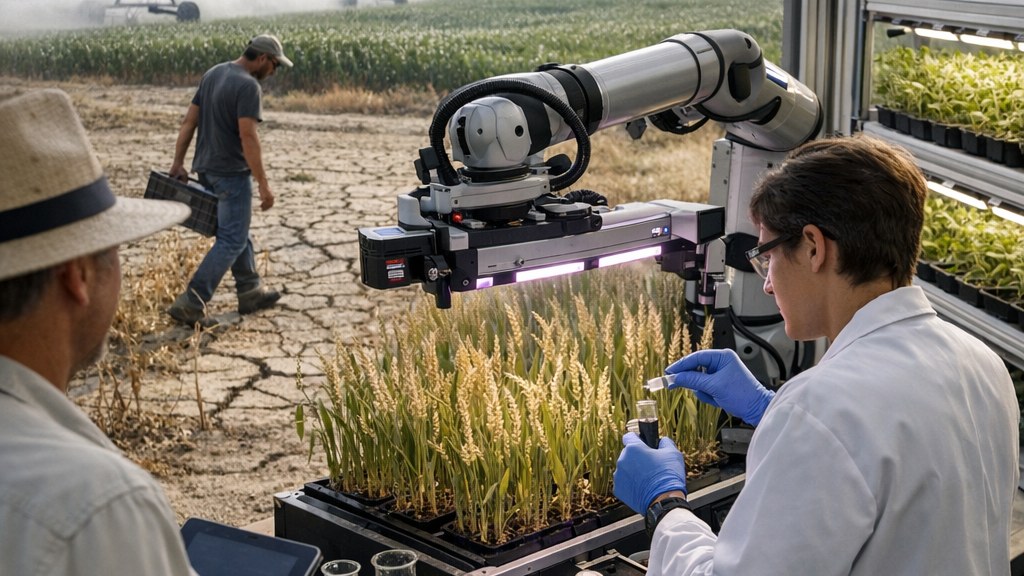
Land is another constraint. The latest global agriculture assessments warn that human-driven land degradation is widening yield gaps and making it harder for farmers to maintain production. Degraded soils hold less water, lose nutrients more easily and are more vulnerable to heat and heavy rain.
Food systems also contribute to the pressures they face. Agrifood systems account for about one-third of human-caused greenhouse gas emissions. In 2023, global agrifood emissions reached about 16.5 billion tonnes of carbon dioxide equivalent. Crop and livestock production, land-use change, transport, packaging, retail and food waste all play a role.
## Science is becoming part of everyday farming
The response is not one single invention. It is a mix of practical changes and new science.
Farmers are adopting drought- and heat-tolerant crop varieties, including maize, beans, rice, wheat and cassava in vulnerable regions. Breeders are using gene banks, field trials and faster screening tools to find traits that can survive hotter seasons and shifting disease patterns.
Water-saving irrigation, soil moisture sensors, satellite monitoring and seasonal forecasts are also becoming more important. Early warning systems can help farmers decide when to plant, irrigate, harvest or move livestock. In places with limited resources, even basic weather alerts can reduce losses.
New food technologies may also help in some markets. Fermentation-based proteins, improved plant-based foods, vertical farming for selected crops and controlled-environment agriculture are attracting research and investment. These tools are not replacements for open-field farming at global scale. But they may add resilience for certain foods, cities and supply chains.
The central challenge is equity. Wealthier farmers and countries can adopt new tools faster. Smallholder farmers, who feed many local communities, often face higher risks and fewer financial options. The future food system will depend not only on invention, but on whether those inventions reach the people most exposed to heat, water stress and unstable markets.
AI Perspective
Food security is becoming a systems challenge, not only a farming challenge. Climate adaptation, affordable nutrition and better use of water and land now need to move together. The countries and communities that build resilience early will be better placed to handle the next shock.


-134c72da.webp)


