[[[SUMMARY_START]]]
Apple is preparing for its first chief executive change since Tim Cook took over from Steve Jobs in 2011.
John Ternus, Apple’s hardware engineering chief, is set to become CEO on September 1, 2026.
The transition puts a product-focused engineer in charge as Apple faces major questions around AI, regulation, supply chains and its next growth engine.
[[[SUMMARY_END]]]
Apple’s next era is now taking shape around John Ternus, the longtime hardware executive chosen to succeed Tim Cook as chief executive. The move signals continuity, but it also raises a clear question for the world’s most valuable consumer technology company: can a product engineer guide Apple through a market that is changing quickly around artificial intelligence, regulation and global manufacturing?
## A planned handover at the topApple announced in April that Tim Cook will move from chief executive to executive chairman of the board on September 1, 2026. Ternus, now senior vice president of hardware engineering, will become CEO on the same date and join the board.
Cook will remain CEO through the summer while working with Ternus on the transition. In his new role, Cook is expected to stay involved in parts of the business, including contact with policymakers around the world. That matters because Apple’s business is closely tied to trade policy, privacy rules, antitrust enforcement and manufacturing decisions across several countries.
The board also set a governance change. Arthur Levinson, Apple’s longtime chairman, will become lead independent director when Cook becomes executive chairman.
The transition is not a sudden break. It follows a long internal succession process and keeps leadership inside Apple. That fits the company’s usual style. Apple often prefers deep internal continuity over outside reinvention.
## Who is John Ternus?
Ternus joined Apple in 2001 and became a vice president of hardware engineering in 2013. He joined Apple’s executive team in 2021 as senior vice president of hardware engineering, succeeding Dan Riccio in that role.
His career has been centered on products, materials, engineering and device design. He has helped oversee hardware work across Apple’s major categories, including iPhone, Mac, iPad, AirPods and Apple Watch. He also has a background in mechanical engineering and worked at Virtual Research Systems before joining Apple.
That experience gives Apple a CEO with strong product roots. Cook, by contrast, became known for operations, supply chains and global execution. Under Cook, Apple expanded well beyond the iPhone while also building large services, wearables and silicon businesses.
The choice of Ternus suggests Apple still sees hardware as the center of its identity. Even as services grow, the iPhone, Mac, Watch, AirPods and Vision products remain the gateways into Apple’s wider ecosystem.
## The company he inherits
Ternus will inherit a far larger company than the one Cook took over in 2011. During Cook’s tenure, Apple’s market value rose from roughly $350 billion to about $4 trillion. Annual revenue grew from $108 billion in fiscal 2011 to more than $416 billion in fiscal 2025.
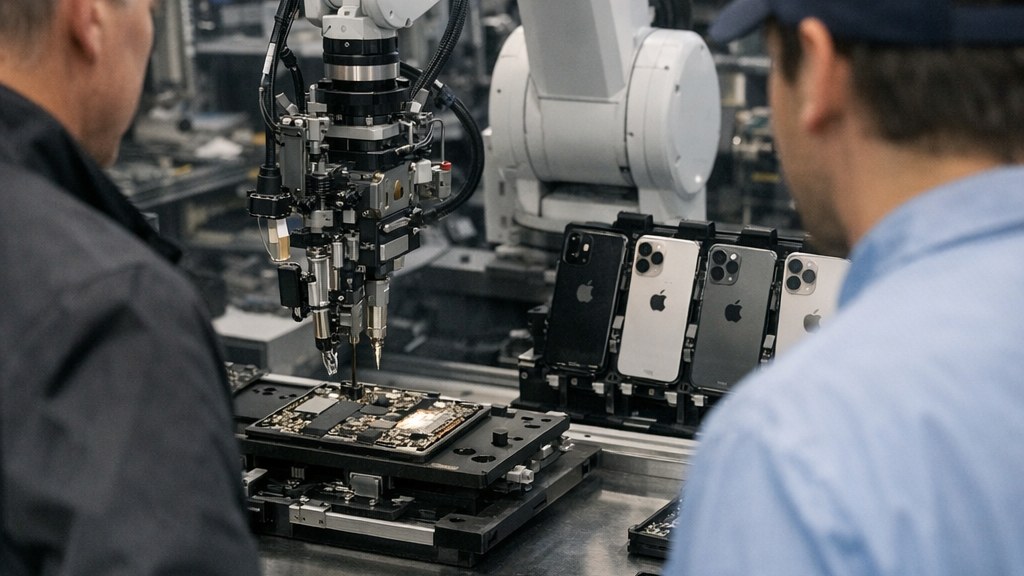
The company’s latest quarterly results show why the handover is happening from a position of strength. For the quarter ended in March 2026, Apple posted revenue of $111.18 billion and net income of $29.58 billion. iPhone revenue reached $56.99 billion, while services revenue was $30.98 billion.
Those figures show that Apple’s core business remains powerful. They also show the scale of the job Ternus is taking on. Any CEO of Apple must protect the iPhone franchise while finding the next major sources of growth.
## The main tests ahead
Artificial intelligence is one of the clearest tests. Apple has introduced Apple Intelligence features across its devices, but some promised Siri upgrades have taken longer than expected. Ternus will need to show that Apple can make AI useful inside everyday products while keeping its focus on privacy and on-device performance.
Regulation is another challenge. In Europe, Apple has had to change parts of its App Store and iPhone software model under digital competition rules. Similar pressure could grow in other markets.
Manufacturing is also changing. Apple has been increasing production in India and Vietnam while still depending heavily on China. Cook was widely viewed as one of the world’s most skilled supply-chain leaders. Ternus will need to manage that same complexity, especially if trade tensions or component shortages rise.
There is also the product question. Apple Watch and AirPods became major businesses under Cook. Apple Vision Pro opened a new category, but mixed-reality devices remain early and expensive. Ternus may be judged by whether Apple can turn new hardware ideas into mainstream products, not just premium experiments.
## A continuity choice with new pressure
Apple’s selection of Ternus is not a sharp turn away from Cook. It is a bet that a respected internal engineer can preserve Apple’s culture while pushing the company into its next product cycle.
The challenge is that Apple’s next era may not be defined only by thinner phones, faster chips or better cameras. It may depend on how well the company blends hardware, software, AI and services into products that feel simple to users.
Ternus will start with a strong balance sheet, a huge customer base and one of the most recognizable brands in the world. He will also start with high expectations. Cook’s era proved Apple could become much larger after Steve Jobs. Ternus now has to prove Apple can keep finding new reasons for customers to stay inside its world.
AI Perspective
Apple’s choice of John Ternus shows that the company still trusts its product culture to guide its future. The next stage will likely depend on whether Apple can make new technologies feel practical, private and easy to use. For customers, the real test will be visible in the products, not in the leadership change itself.


-134c72da.webp)


