[[[SUMMARY_START]]]
Phones, apps, cameras and connected devices now track many parts of daily life. What once felt exceptional has become routine in shopping, work, school, travel and public spaces.
People often say they feel uneasy about this data collection, but many also accept it as the price of convenience, safety or access.
The result is a quiet shift: surveillance is no longer limited to governments or police. It is built into ordinary systems that millions use every day.
[[[SUMMARY_END]]]
Surveillance used to sound like something distant. It brought to mind intelligence agencies, criminal investigations or secure government sites. Today it is woven into ordinary life.
A smartphone checks location in the background. A doorbell camera watches the street. A workplace program logs activity. A school device scans messages for signs of risk. A car can be recorded as it passes roadside cameras. In many cases, these systems operate quietly, continuously and at large scale.
That change did not happen all at once. It grew through convenience, safety claims and business models built on data. Over time, habits that once seemed intrusive became familiar enough to fade into the background.
Much of modern surveillance is not experienced as surveillance at all. It arrives as a feature, a service or a security layer.
Apps ask for location to offer directions, delivery updates or nearby recommendations. Retailers and advertisers use identifiers to follow behavior across devices and services. Connected health products and wearables collect sensitive information that can reveal routines, sleep, exercise and other personal patterns. Regulators in the United States have recently tightened rules for health apps and connected devices, showing how much intimate data now sits outside traditional medical settings.
This is one reason the shift feels normal. The tracking is often packaged as useful. A customer gets a smoother app. A family gets a video alert from the front door. A commuter gets a faster route. The exchange can feel small in the moment, even when the long-term record becomes large.
## Public spaces are more visible than before
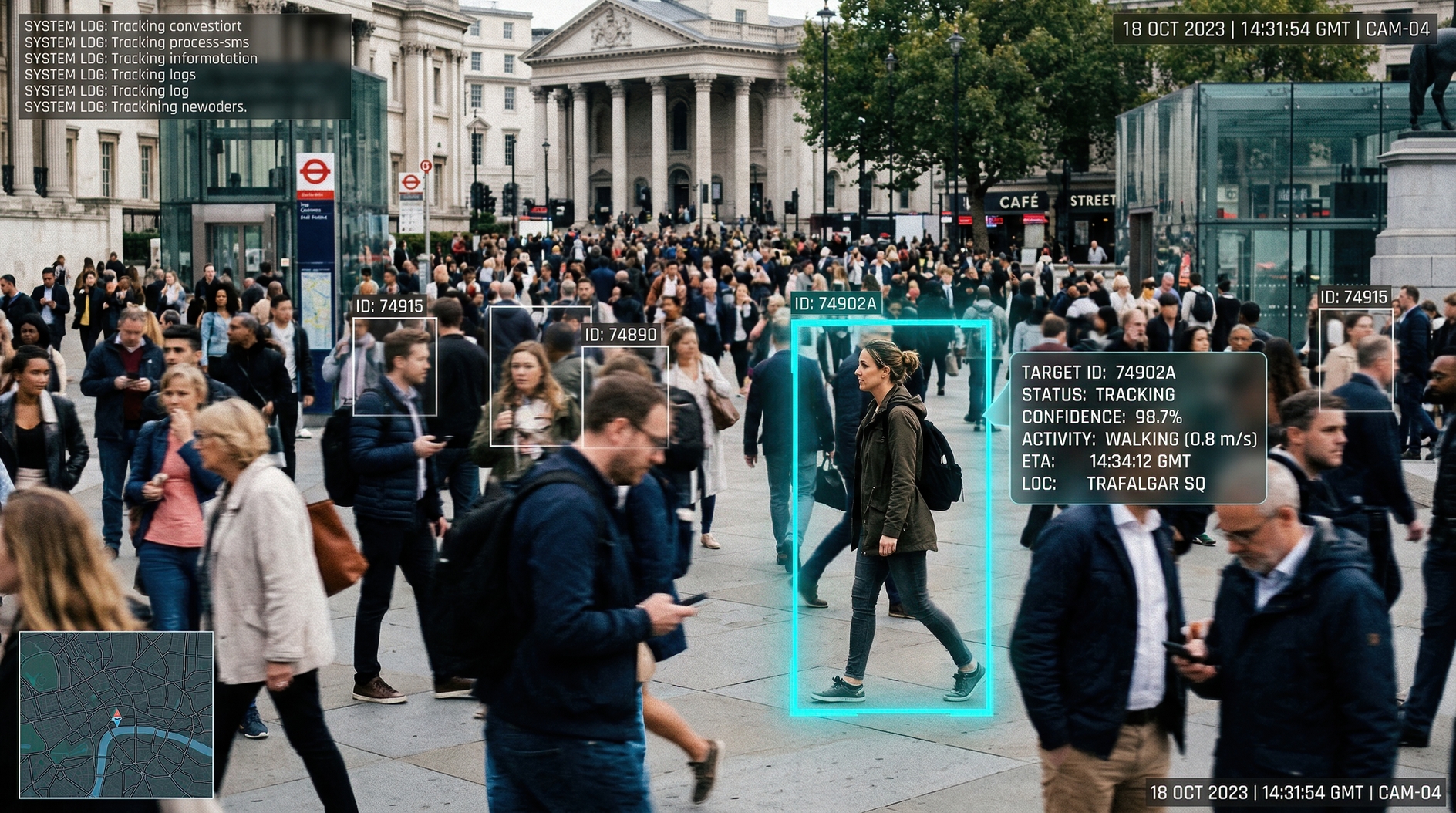
The same pattern has spread beyond phones and homes. Cameras in public and semi-public spaces have become more powerful, cheaper and easier to connect.
Facial recognition remains one of the most contested examples. European privacy bodies have repeatedly warned that remote biometric identification in publicly accessible spaces carries very high risks for privacy and other rights. New European AI rules also place strict limits and transparency duties on some biometric and emotion-recognition uses.
Road travel offers another example. Automatic license plate readers can capture the time, date and location of passing vehicles in bulk. Civil liberties groups say these systems are increasingly used to build large databases of ordinary movement, not just to flag stolen cars or urgent threats. In parts of the United States, disputes over roadside camera networks have grown as officials and advocates argue over retention, access and oversight.
Doorbell cameras have also changed the feel of neighborhoods. They are sold as consumer safety products, but they also create private camera networks that can overlap with police requests and public monitoring. This blurs the line between private choice and wider social surveillance.
## Work and school added new layers
In the workplace, employers can monitor badge swipes, keystrokes, browsing, location, driving patterns and productivity metrics. Research on platform and gig work has shown how algorithms can shape hiring, pay, discipline and dismissal while continuously measuring workers in the background. Public opinion in the United States suggests many people are uncomfortable with this trend, especially when artificial intelligence is used to track movement or evaluate performance.
Schools have followed a similar path. Student devices, filtering tools, proctoring software, social media monitoring and even facial-recognition systems have all been used in the name of safety or academic integrity. Privacy advocates warn that these tools can create detailed records of children’s behavior and can extend monitoring beyond the classroom and into home life.
In both work and school, the same logic appears again and again: monitoring is introduced as a practical response to risk, inefficiency or liability. Once installed, it becomes part of the normal system.
## Why people accept it
Surveys show that many Americans are concerned about how companies and governments use their data. Large majorities say they feel they have little control over what is collected and limited understanding of how the information is used. Yet concern has not stopped the spread.
Part of the answer is that refusal is hard. Many services are essential, popular or deeply embedded in daily routines. Reading privacy terms is difficult. Opt-out tools are uneven. In schools and workplaces, the choice may be limited or nonexistent.
Another reason is that surveillance is fragmented. A camera here, an app permission there, a school filter, a work dashboard, a data broker, a traffic system. Each piece can seem narrow. Together they form a broad picture of where people go, what they do and how they behave.
That is how normalization works. The systems become ordinary before society fully decides how far they should go.
AI Perspective
Everyday surveillance became normal because it arrived through useful products and familiar routines, not through one dramatic change. That makes it harder to notice and harder to resist. The central question now is not whether monitoring exists, but what limits people and institutions are willing to set around it.


-134c72da.webp)


