[[[SUMMARY_START]]]
Artificial intelligence is changing work in ways that do not always show up in public debate. Alongside concerns about automation, companies are quietly hiring people to build, monitor, govern, train, and support AI systems. Many of these roles sit behind the scenes, from data specialists and auditors to electricians, technicians, and workers linked to the fast-growing data center buildout.
[[[SUMMARY_END]]]
Artificial intelligence is often discussed in terms of the jobs it may replace. But a second story is unfolding at the same time. Across offices, factories, cloud networks, and training programs, AI is also creating work that is less visible to the public.
Some of these jobs are highly technical. Others are not. They include people who label and clean data, test models, check outputs for bias or safety, write internal AI policies, train co-workers, upgrade power systems, and build data centers that support the new tools. The result is an emerging labor market that spreads well beyond software engineering.
Recent global labor research shows that AI is reshaping jobs through task changes as much as through outright replacement. That matters because many new roles do not arrive with a dramatic new title. Instead, they appear as added duties inside existing jobs, or as hybrid roles that blend domain knowledge with AI skills.
Large employer surveys point to both disruption and creation. One widely followed global forecast for the rest of this decade says employers expect both major displacement and major job creation, with new roles outnumbering lost ones overall. Separate labor-market data has also shown strong growth in AI-related hiring over the past two years, even during a weaker broader hiring environment.
That pattern helps explain the “invisible economy” around AI. A company may not advertise for dozens of futuristic-sounding positions. It may instead hire a compliance manager who can review AI use, a marketing worker who can operate AI tools, a nurse or teacher trained to use AI support systems, or an internal auditor who can test automated decisions.
## New jobs behind the software
The most obvious gains have come in data and technical fields. Demand remains strong for AI engineers, machine learning specialists, and data scientists. In the United States, data scientist employment is projected to grow much faster than average over the next decade.
But many AI-linked jobs are one step removed from model building. Companies need people to prepare training data, maintain pipelines, evaluate model performance, and monitor systems once they are deployed. As AI spreads into routine business functions, firms are also adding workers in governance, security, risk, and compliance.
This is becoming more important as executives admit adoption is moving faster than oversight. That gap is creating demand for people who can audit AI systems, document how they work, track their risks, and make sure internal rules are followed. In practice, that can mean lawyers with technical literacy, auditors who understand machine outputs, cybersecurity teams protecting AI workflows, and operations staff who check whether automated tools are reliable enough for daily use.
Another slice of the hidden labor market is training. Many organizations now need managers, instructors, and internal champions who can teach workers how to use AI productively and safely. That work rarely gets headlines, but it is becoming central as firms try to move from small experiments to everyday use.
## Physical work is part of the AI boom too
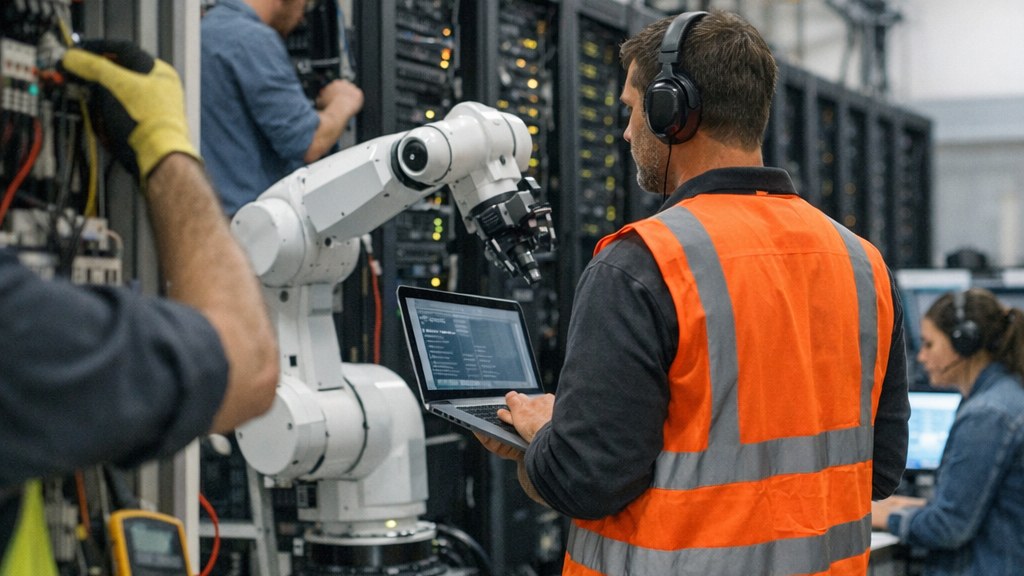
That is creating demand for electricians, construction crews, HVAC specialists, network technicians, equipment installers, and maintenance workers. Recent industry reporting and employer announcements have highlighted how the race to expand AI computing capacity is feeding construction hiring and apprenticeship efforts, especially around major data center projects.
This side of the AI boom is easy to miss because the public tends to focus on chatbots and software. Yet the growth of AI services depends on warehouses full of servers, backed by power, water, land, and transport links. That means some of the jobs created by AI look more like skilled trades than office work.
## Skills are shifting faster than job titles
Another reason the AI job market can be hard to see is that skill demand is changing faster than official role names. Recent OECD analysis found that job skill requirements have shifted sharply in a short period, with many occupations changing a large share of the skills employers ask for.
This favors workers who can combine industry knowledge with AI fluency. In finance, healthcare, logistics, education, and customer operations, employers increasingly need people who understand both the business process and the AI tool layered onto it.
At the same time, risks remain real. Research continues to show that some entry-level and routine work is under pressure, especially where generative AI can handle basic writing, support, coding, or research tasks. That makes retraining and job transition support a central part of the story, not a side issue.
The hidden AI economy, then, is not a simple tale of replacement or rescue. It is a reshaping of work across visible and invisible layers. Some jobs are being automated. Others are being upgraded. And many of the new roles emerging now are support roles, hybrid roles, and infrastructure roles that do not yet stand out in headline employment counts.
As companies invest more in AI, the next wave of hiring may not always happen under the label of “AI jobs.” It may appear in quieter ways: in maintenance teams, audit units, training departments, data operations, and skilled trades that keep the whole system running.
AI Perspective
AI’s effect on jobs is easier to understand when work is viewed as a chain, not a single role. New technology often creates support, oversight, and infrastructure work before the public has a clear name for it. The main challenge now is making sure workers can move into these new openings fast enough.


-134c72da.webp)


-6c40e5ef.webp)

-1d29b0b2.webp)
-2721737f.webp)
-55bf1fe2.webp)