[[[SUMMARY_START]]]
Human and AI-made content are becoming much harder to tell apart. Recent research and policy work show that text, audio and other media can now look or sound convincingly human, while detection tools still struggle. That is pushing governments, standards groups and technology companies toward labeling and provenance systems rather than relying on simple detection alone.
[[[SUMMARY_END]]]
The boundary between human-made and AI-made content is fading fast. New studies, official evaluations and industry standards all point in the same direction: in many cases, people and software now struggle to reliably tell the difference.
That shift is changing a basic assumption of the internet era. For years, most users could treat written posts, photos, recordings and messages as likely human unless there was clear evidence otherwise. In 2026, that is no longer a safe default.
That change is visible in official testing as well. A U.S. standards effort focused on generative AI text is explicitly built around a hard new reality: some systems can generate writing that is effectively meant to be indistinguishable from human work. The evaluation does not just test generators. It also tests “discriminators,” or systems designed to decide whether text was written by a person or by a model.
## Detection tools are not keeping up
The problem is not only that AI content is improving. It is also that detection remains weak and inconsistent.
A 2025 academic study of university lecturers found that both humans and AI detectors performed only slightly better than chance when asked to classify short academic passages as human-written or AI-generated. The gap narrowed further as the writing quality improved. Professional-level AI text was especially hard to identify.
That matters far beyond schools. Similar weaknesses apply to customer support messages, product descriptions, social media posts, marketing copy and public comments. In practice, many readers are judging style, tone and fluency rather than origin. Modern models are increasingly good at matching those signals.
Audio shows the same pattern. Research published in 2025 found that listeners could not reliably distinguish cloned voices from recordings of real speakers. In daily life, that raises the stakes for fraud, impersonation and misinformation. A realistic voice note or phone call can now carry the emotional weight of human speech even when it is synthetic.
## The response is shifting from detection to provenance
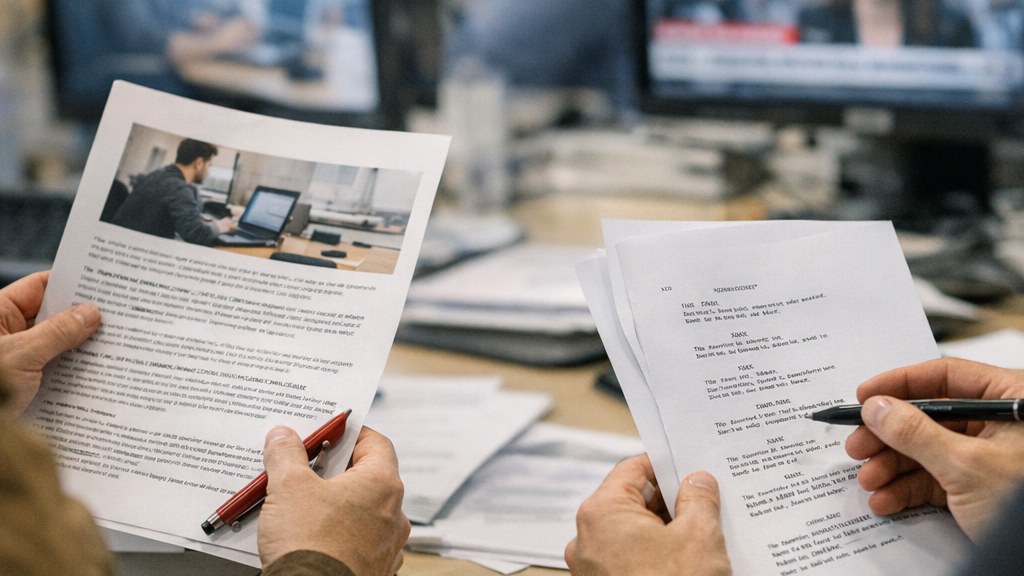
One major effort is Content Credentials, an open standard for attaching provenance data to media files. The standard was updated again in early 2026, and its backers say it is now used in thousands of live applications. The aim is simple: give images, video, audio and some documents a traceable history that can show whether AI tools were involved, what edits were made and whether metadata has been tampered with.
This approach does not solve everything. Metadata can be removed, altered or lost when files are reposted across platforms. Not every creator or tool uses the same systems. And provenance only helps when content starts inside a trusted chain. But it is increasingly seen as more practical than relying on style-based AI detectors alone.
## Regulation is starting to catch up
Rules are also moving toward disclosure. In Europe, transparency duties under the AI Act are set to become more important in 2026, including obligations tied to synthetic and manipulated content such as deepfakes. The broader direction is clear even where legal details vary by jurisdiction: if audiences cannot reliably detect AI content on their own, the burden shifts toward the systems and platforms that create or distribute it.
That does not mean every AI-assisted sentence will need a warning label. The harder question is where to draw the line. Many people now use AI to edit, summarize, translate, brainstorm or polish work that began with a human draft. Others write the structure themselves and let a model fill in examples or improve clarity. In those mixed cases, authorship is no longer binary.
That may be the biggest reason the line is blurring. The internet is not splitting into “human content” and “AI content.” It is filling up with hybrid work. A newsletter may be . A student paper may combine original argument with AI-assisted phrasing. A business email may be written by a person and softened by a chatbot before it is sent.
For users, the result is a new kind of uncertainty. Fluency no longer proves humanity. Imperfection no longer proves authenticity. Trust will depend less on whether content feels human and more on whether its origin can be checked, its context understood and its claims verified.
AI Perspective
The important shift is not just that AI content is improving. It is that authorship itself is becoming mixed, with people and tools working together in the same piece of content. That means trust online may soon depend less on guessing who wrote something and more on transparency about how it was made.


-134c72da.webp)


-6c40e5ef.webp)

-1d29b0b2.webp)
-2721737f.webp)
-55bf1fe2.webp)
-9f154954.webp)