[[[SUMMARY_START]]]
A clear night sky can still do something rare in modern life: stop people in their tracks. That simple act of looking up continues to spark questions that lead to research, new technology, and new generations of scientists. From school telescopes to major space missions, astronomy remains a powerful gateway to exploration.
[[[SUMMARY_END]]]
The oldest habit in science may be one of the simplest: looking up.
Long before satellites, laboratories, and space probes, people studied the sky to track seasons, navigate, and make sense of the world. That instinct is still alive today. Across education, public outreach, and major research missions, the night sky continues to inspire scientific exploration in ways that are both deeply human and highly practical.
## A gateway into science
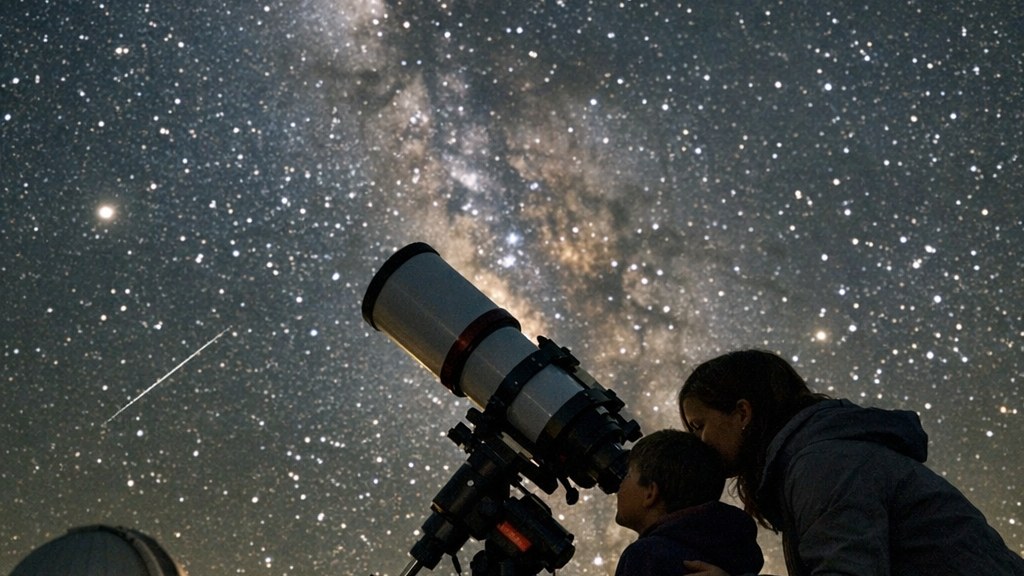
Astronomy has unusual reach because it is visible to almost everyone. A child does not need to visit a laboratory to notice the Moon changing shape or to ask why stars appear to move across the sky. Educators have long treated that accessibility as a doorway into science, technology, engineering, and mathematics.
Programs built around school telescopes, skywatching activities, and hands-on astronomy lessons continue to grow. In the United States, a new rural schools effort launched by the Smithsonian Astrophysical Observatory is designed to provide telescopes, teacher support, and astronomy-based lessons to students who often have dark skies but fewer classroom resources. The program is aimed at helping rural and tribal nation schools turn local skies into a science asset.
Internationally, astronomy outreach groups are making the same case. The International Astronomical Union’s public outreach work presents astronomy as a shared human experience that can build curiosity and scientific thinking. European education programs have also leaned on astronomy to help teachers connect classroom learning with current missions and real observations of the sky.
## Wonder backed by hard data
The emotional pull of the night sky is only one side of the story. Modern astronomy also produces enormous amounts of data that feed some of the biggest questions in science.
New and ongoing missions are widening that view. NASA’s SPHEREx observatory is designed to create a full-sky map in infrared light, helping researchers study the history of the universe and the ingredients for planets and life. The James Webb Space Telescope continues to reveal surprisingly early galaxies and fresh details about the young universe. Europe’s Euclid mission is mapping the large-scale structure of the cosmos in an effort to better understand dark matter and dark energy.
Another major observatory, the Nancy Grace Roman Space Telescope, is now complete and is being prepared for launch in late 2026. Its wide-field surveys are expected to speed up the search for exoplanets and improve large cosmic maps. Together, missions like these show how a basic act of skywatching has evolved into a global effort to measure the universe with extraordinary precision.
## Looking up also improves life on Earth
Observing techniques developed for space science support Earth observation, hazard monitoring, imaging systems, and advanced computing. Work on satellites and instruments also strengthens skills in optics, robotics, communications, and data analysis. At the same time, studies carried out in orbit continue to support research with benefits for medicine, materials, and future exploration.
This broader effect helps explain why astronomy often attracts support beyond the scientific community. It is easy to see the stars as distant, but the effort to understand them tends to build capabilities that spill into everyday life.
## The role of access to dark skies
The simple act of looking up is not equally available everywhere. Light pollution has made the night sky harder to see for many urban residents, even as public interest in astronomy remains strong. That has increased attention on dark-sky education, observatories, and community programs that preserve access to visible stars.
In rural areas, dark skies can be a major advantage for students, amateur astronomers, and researchers. New science centers and education initiatives are starting to treat those skies not just as scenery, but as part of a learning environment. The idea is straightforward: when people can see more, they often want to know more.
## A habit that still matters
Even in an age of artificial intelligence, commercial rockets, and giant telescopes, the first step into science can remain remarkably ordinary. Someone notices something in the sky. Then they ask a question.
That pattern links ancient stargazers to today’s researchers studying cosmic expansion, interstellar objects, solar activity, and distant worlds. It also links public wonder to serious scientific work. Looking up may be simple, but it still helps push exploration forward.
AI Perspective
This topic shows that science often begins with attention before it begins with equipment. The sky remains one of the few things that can inspire both personal wonder and large international research efforts at the same time. That makes astronomy a rare bridge between everyday experience and frontier science.


-134c72da.webp)


-6c40e5ef.webp)

-1d29b0b2.webp)
-2721737f.webp)
-55bf1fe2.webp)