[[[SUMMARY_START]]]
Digital tools are making daily life faster, smoother and easier to navigate.
That convenience is changing how people read, learn, shop, work and pay attention.
Recent surveys show heavy social media use among teens, wider AI adoption at work and school, and weaker reading habits among some groups.
The challenge now is to keep useful convenience without losing patience, memory and deeper thought.
[[[SUMMARY_END]]]
A quiet change is shaping modern life. More of the small delays that once forced people to think, wait, choose or struggle are being removed. Autoplay videos, one-click shopping, tap-to-pay, instant answers and AI-written summaries all reduce effort. They also reduce friction. The result is a world that often feels easier, but not always deeper.
## Convenience is now the defaultFriction used to be built into everyday life. A person had to look up a phone number, wait for a letter, stand in a line, search a library shelf, rewrite a draft or sit with a hard problem before moving on.
Many of those moments are gone. A map app gives the route. A streaming service starts the next episode. A search engine completes the question. A chatbot can outline an essay, summarize a report or draft an email in seconds.
This shift has clear benefits. It saves time. It helps people with disabilities. It supports workers under pressure. It makes information easier to reach. It can reduce small daily burdens that once took hours.
But researchers, teachers and workplace leaders are paying closer attention to the trade-off. Some kinds of friction are not just obstacles. They are part of how people learn, remember and form judgment.
## Attention is being pulled into faster loops
Recent survey data show how deeply fast digital systems have entered daily life, especially for young people. In a national survey of U.S. teens conducted in late 2025, about one in five teens said they used TikTok or YouTube almost constantly. Across five major social platforms, 36 percent of teens said they used at least one almost constantly.
The same survey found that AI chatbots are now common in teen life. Nearly two-thirds of teens said they had used an AI chatbot, and ChatGPT was the most widely used among the tools listed.
These numbers do not prove that technology alone is weakening attention. Teen life includes school pressure, social pressure, family demands and pandemic-era disruptions. But the data show that many young people now spend large parts of the day inside systems designed for speed, recommendation and quick response.
That environment rewards movement. Scroll again. Tap again. Ask again. Skip the hard paragraph. Watch the summary. The habit can make slower forms of attention feel unusually difficult.
## Reading shows the tension
Reading is one place where the loss of friction is visible. A 2025 U.S. adult survey found that 75 percent of adults had read at least one book in any format during the previous 12 months, while 25 percent had read none. The same survey found that only 7 percent had taken part in a book club.
Other federal arts data show a longer decline in some reading measures. In 2022, 53 percent of U.S. adults read literature or books of some kind, down from 57.1 percent in 2017. The share who read at least one print or electronic book was 48.5 percent in 2022, lower than a decade earlier under that measure.
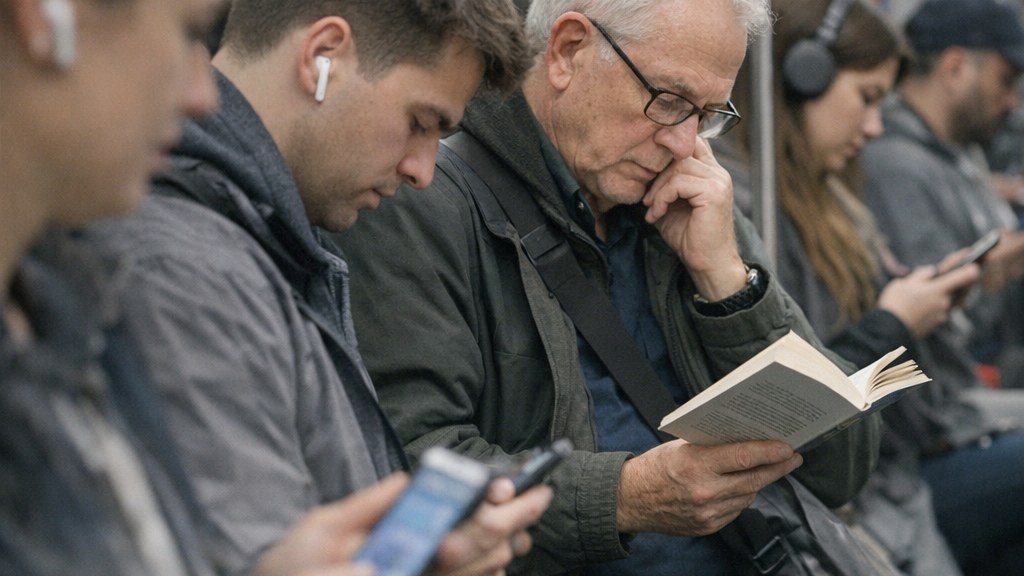
Reading a long book requires friction. It asks the reader to hold a thread, remember earlier pages, tolerate confusion and build meaning over time. Those are not just reading skills. They are also civic, professional and personal skills.
## AI removes effort, but also raises new questions
The workplace is moving in the same direction. A February 2026 survey of U.S. employees found that half used AI in their role at least a few times a year. Thirteen percent used it daily, and 28 percent used it a few times a week or more.
Workers often use AI to draft text, summarize information and generate ideas. Many say it helps them work faster. That is the promise of the technology.
The question is what happens when the draft comes too easily. Writing often helps people discover what they think. Searching teaches people how to judge sources. Struggling with a problem can build skill. If tools remove too much of that process, users may finish tasks without gaining the deeper benefit of doing them.
This does not mean AI should be rejected. It means the design and use of AI matter. A tool that helps a student plan, test and revise can support learning. A tool that simply replaces effort can weaken it.
## Designing for useful friction
Some institutions are already trying to restore healthy friction. Schools are asking students to show drafts, explain methods and discuss how AI was used. Employers are training workers to verify AI outputs rather than accept them automatically. Families are setting screen-free times, reading routines and device limits.
Design choices can also help. Apps can slow sharing before a user reposts an article they have not opened. Platforms can offer stopping points instead of endless feeds. AI tools can ask users to compare options, cite evidence or revise their own reasoning.
The goal is not to make life harder for its own sake. The goal is to protect the forms of effort that create understanding.
Friction can be annoying. It can also be where depth begins.
AI Perspective
The useful question is not whether technology should be fast. Speed can help people and remove real barriers. The harder task is deciding where slowness, effort and waiting still serve a human purpose.


-134c72da.webp)


-6c40e5ef.webp)
