[[[SUMMARY_START]]]
Workplace presence is changing as more teams rely on chat, email, video calls and status indicators instead of shared office time.
Recent workplace data shows heavy daily message traffic, more ad hoc meetings and growing pressure to respond quickly.
Hybrid work remains popular, but companies are still trying to define fair rules for availability, focus time and after-hours contact.
[[[SUMMARY_END]]]
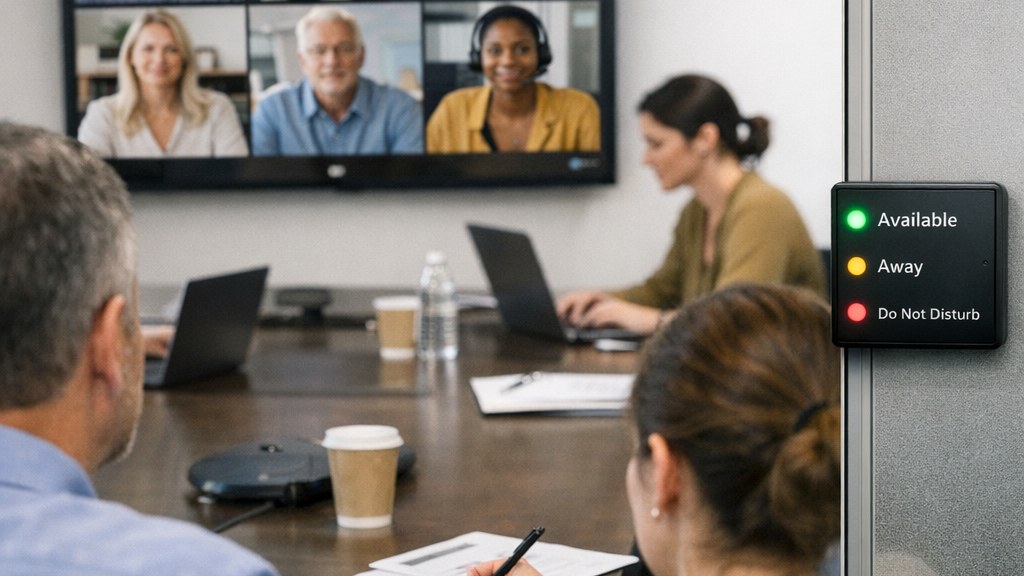
For many office workers, being “at work” no longer means sitting where colleagues can see them. It increasingly means being reachable. A green status light, a quick reply, a calendar slot and a message read receipt have become new signals of commitment in the digital workplace.
The shift is reshaping how teams judge presence, trust and productivity. It is also creating a new problem: workers can be highly available while still lacking the time and attention needed to do their best work.Recent workplace research points to a clear pattern. Remote and hybrid work have made location less important for many knowledge jobs. At the same time, digital communication has filled the gap left by less face-to-face contact. The result is a workday that can begin before breakfast, continue through messages between meetings and return late at night.
## The office is no longer the only signal
Hybrid work is now a normal part of white-collar life in the United States. Among employees with remote-capable jobs, a majority work either hybrid or fully remote. Many workers also say they prefer a mixed arrangement rather than a full return to the office.
This has changed what managers and colleagues can observe. In an office, presence was visible. People saw who arrived, who joined a hallway conversation and who stayed late. In a distributed team, those signals are replaced by digital traces. A person may appear present through a chat status, fast replies, calendar activity, comments in shared documents or attendance in video meetings.
That makes work more flexible. A software developer in Seattle can work with a designer in London. A customer-support team can cover more time zones. A parent can join a meeting from home and still handle family needs. But the same tools can make availability feel constant.
## The workday is stretching
Microsoft’s 2025 Work Trend Index research found that the average employee received 117 emails and 153 Teams messages a day. It also found that 40% of workers checked email before 6 a.m., while meetings after 8 p.m. rose 16% from the prior year. The same analysis said workers were interrupted about every two minutes by meetings, email or chat notifications.
The pattern shows how availability has become a form of workplace presence. A worker who responds quickly may be seen as engaged, even if rapid response comes at the cost of deeper work. A worker who blocks time to focus may be productive, but less visible.
Ad hoc communication adds to the pressure. The Microsoft data found that 57% of meetings were unscheduled calls without calendar invites. That kind of fast coordination can help teams solve urgent problems. It can also make the day harder to plan.
## Workers want flexibility, not endless reach
The tension is visible in worker preferences. A 2025 survey of U.S. employees with jobs that can be done from home found that 75% were working remotely at least some of the time. Nearly half of those workers said they would be unlikely to stay in their job if working from home were no longer allowed. Among hybrid workers, most did not want to work from home all the time. They preferred a mix.
That points to a more careful conclusion. The main demand is not simply to avoid offices. It is to keep some control over where and when work happens.
Employers are responding in different ways. Some are requiring more office days to rebuild collaboration and mentoring. Others are setting clearer rules for quiet hours, meeting-free blocks, response times and documentation. Some companies are using artificial intelligence to summarize meetings, draft messages or help workers search internal knowledge bases.
These changes show that the workplace debate has moved beyond remote versus office. The deeper question is how much access an employer should expect to a worker’s attention.
## New rules are still forming
The next stage of workplace technology may depend less on adding more communication tools and more on limiting when they are used. Teams need shared expectations about what must be answered now, what can wait and what should be documented for later.
For global companies, this is especially important. Cross-time-zone work can help organizations hire talent anywhere. But without clear boundaries, it can also turn one person’s normal workday into another person’s late-night obligation.
Presence once meant being physically there. Availability now often means being digitally reachable. The most effective workplaces are likely to be those that separate the two. Being online is not the same as being focused. Replying fast is not always the same as doing important work.
AI Perspective
The shift from presence to availability is one of the clearest signs that work has become more digital and less place-based. The challenge is not the tools themselves, but the habits that grow around them. Healthy teams will need to protect both connection and quiet time.


-134c72da.webp)


-6c40e5ef.webp)

-1d29b0b2.webp)