[[[SUMMARY_START]]]
Forty years after the Chernobyl disaster, its effects still shape public health, energy policy and nuclear safety rules.
The 1986 explosion in reactor 4 forced mass evacuations and left a long legacy of contamination and illness.
As governments reconsider nuclear power for low-carbon electricity, Chernobyl remains a warning about design, secrecy, war risk and public trust.
[[[SUMMARY_END]]]
Forty years after reactor 4 exploded at the Chernobyl nuclear power plant, the disaster remains more than a chapter in Soviet history. It is still a live issue for Ukraine, for radiation science and for every country weighing the future of nuclear power.
## A night that changed nuclear powerThe Chernobyl accident began in the early hours of April 26, 1986, during a low-power safety test at the plant in northern Ukraine, then part of the Soviet Union. The test went wrong. The RBMK reactor became unstable, leading to explosions and a fire that destroyed the reactor building and sent radioactive material into the air.
The nearby city of Pripyat was evacuated the next day. In 1986, about 116,000 people were moved from the most contaminated areas. In the years that followed, the number of people displaced rose to roughly 350,000.
The emergency response drew in hundreds of thousands of workers, often called liquidators. They included firefighters, soldiers, engineers, miners and plant staff. Many worked in dangerous conditions to put out fires, clear debris, build barriers and limit the spread of radioactive contamination.
The human cost is still difficult to count with precision. Twenty-eight emergency workers died in 1986 from acute radiation sickness. Many more people lived for years with medical, social and economic consequences. Studies of affected areas have shown a clear rise in thyroid cancer among people who were children or adolescents at the time and were exposed to radioactive iodine, often through contaminated milk.
## A legacy written into safety rules
Chernobyl changed how the world thinks about nuclear risk. It showed that a severe accident could cross borders, damage public confidence and overwhelm national systems that were not ready for open communication.
After the disaster, international rules on early notification and emergency assistance were strengthened. Nuclear operators and regulators placed more emphasis on safety culture, independent oversight, staff training and accident preparedness. The design and operation of Soviet-era RBMK reactors were also changed to reduce the risk of similar instability.
The lessons were not only technical. The slow public release of information in 1986 became part of the disaster’s legacy. It reinforced the idea that transparency is central to nuclear safety. People need fast, reliable information during a nuclear emergency, even when facts are incomplete and fear is high.
Chernobyl also left behind a long engineering challenge. The destroyed reactor was first covered by a concrete and steel shelter built in extreme conditions in 1986. Decades later, a larger New Safe Confinement structure was placed over the site to contain radioactive material and allow future dismantling work.
## Ukraine’s old wound meets a new war
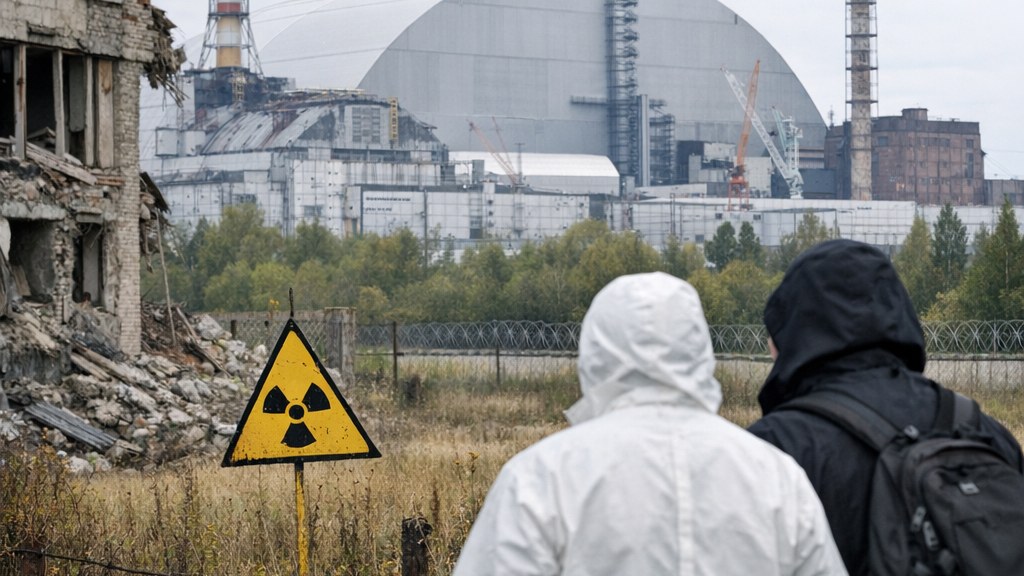
Russian forces occupied the Chernobyl site at the start of the 2022 invasion and later withdrew. The occupation raised concern about staff stress, site security, radiation monitoring and the protection of nuclear facilities during armed conflict.
In February 2025, a drone strike damaged the New Safe Confinement structure. Radiation monitoring at the site did not show an increase after the strike, but the damage underlined a new reality: nuclear safety now includes protection from military threats, not only protection from equipment failure or human error.
The site itself no longer produces electricity. Ukraine shut down the last Chernobyl reactor in 2000. But the plant remains active as a decommissioning, waste management and monitoring site. The exclusion zone also remains a symbol of both danger and resilience, with abandoned towns, controlled access areas and ongoing scientific study.
## The debate over nuclear power is not over
Chernobyl did not end nuclear power. It did change the terms of the debate.
Today, many governments are again looking at nuclear energy as a source of steady, low-carbon electricity. Climate goals, energy security concerns and rising power demand have renewed interest in extending old reactors, building new large reactors and developing small modular reactors.
Global nuclear capacity stood at about 420 gigawatts at the end of 2025, with reactors operating in more than 30 countries. Nuclear reactors with a combined capacity of about 78 gigawatts were under construction in 15 countries, with China accounting for a large share of that work.
Supporters argue that nuclear power can help cut carbon emissions while providing electricity when wind and solar output falls. Critics point to high costs, long construction times, radioactive waste, accident risk and the need for strong regulation over many decades.
Chernobyl sits at the center of that argument. It is used by opponents as proof that nuclear accidents can have lasting consequences. It is used by supporters as proof that nuclear safety must be treated as a permanent public duty, not as a one-time engineering problem.
Forty years later, the disaster’s clearest lesson may be that nuclear power depends on trust. That trust rests on strong design, honest institutions, trained workers, secure sites and the ability to prepare for events that once seemed unlikely.
AI Perspective
Chernobyl remains powerful because it connects past failure with present choices. The future of nuclear energy will depend not only on new technology, but also on public confidence and responsible oversight. The anniversary is a reminder that safety, openness and preparedness must stay at the center of any nuclear plan.


-134c72da.webp)


-6c40e5ef.webp)

-1d29b0b2.webp)