[[[SUMMARY_START]]]
Europe is warming more than twice as fast as the global average, making it the fastest-warming continent.
Recent climate data show 2025 brought widespread heat, record wildfire damage, low river flows and shrinking snow and ice.
Adaptation efforts are expanding, but risk assessments warn that policy and infrastructure changes are not keeping pace with the speed of climate impacts.
[[[SUMMARY_END]]]
Europe’s climate is changing faster than many of its systems can adjust. New assessments of 2025 conditions show a continent under pressure from rising heat, drought, wildfires, shrinking snow cover, glacier loss and warmer seas. The risks are already affecting health, water supplies, farming, infrastructure, energy and ecosystems.
## A continent warming at unusual speedEurope is now the fastest-warming continent on Earth. Long-term monitoring shows it has been warming more than twice as fast as the global average since the 1980s.
The latest five-year averages put Europe’s land warming at about 2.4°C above pre-industrial levels. The global figure is about 1.4°C. The Arctic is warming even faster, and parts of Europe extend into that region.
Several factors help explain the trend. Land warms faster than oceans. Europe’s snow and ice cover is shrinking, which reduces the amount of sunlight reflected back into space. Changes in atmospheric circulation have also favored more frequent and more intense heatwaves in parts of the continent.
## 2025 showed how broad the pressure has become
In 2025, at least 95% of Europe experienced above-average annual temperatures. Five of Europe’s warmest years have all occurred since 2019, and the ten warmest since 2014.
One of the clearest examples came in sub-Arctic Fennoscandia, the region covering northern Norway, Sweden and Finland. In July 2025 it experienced its most severe heatwave on record. The event lasted 21 days. Temperatures near and within the Arctic Circle reached or exceeded 30°C, with a peak of 34.9°C in Frosta, Norway.
This kind of heat is especially disruptive in places built around colder conditions. Buildings, transport systems, health services, forests and wildlife in northern regions are often less prepared for long periods of high temperatures.
## Water, snow and fire risks are changing
The warming is reshaping Europe’s water cycle. In 2025, river flow across Europe was below average for 11 months. Around 70% of rivers had below-average annual flow. Low river levels can affect drinking water, farming, hydropower, river transport and freshwater ecosystems.
Snow conditions also weakened. End-of-season snow cover extent was 31% below average, while snow mass was 45% below average. Both were the third lowest in a 42-year record. The largest negative snow anomalies were seen in eastern Europe.
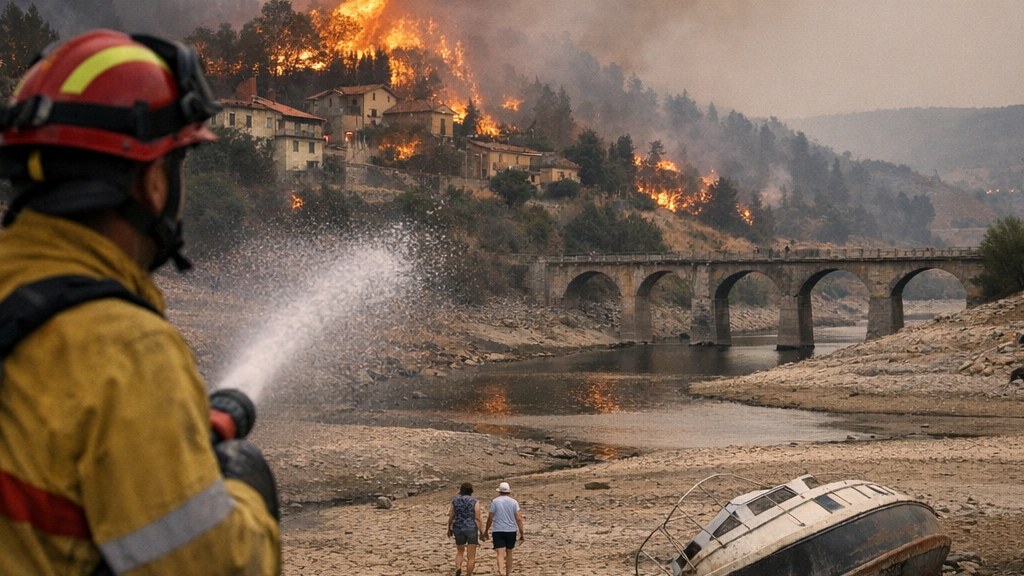
Wildfire damage also reached a new high. Fires burned about 1,034,550 hectares across Europe in 2025, the largest area on record. The biggest contributions came from fires on the Iberian Peninsula in August. Spain and Portugal both saw record cumulative burned areas by the end of that month.
## Adaptation is moving, but not fast enough
Europe has made progress on climate policy, clean energy and adaptation planning. Renewables supplied 46.4% of Europe’s electricity in 2025. Solar power reached a record share of 12.5%.
But cutting emissions and preparing for impacts are different tasks. Europe must strengthen homes, hospitals, farms, transport routes, power systems and water networks for a climate that is already more extreme.
The first continent-wide climate risk assessment identified 36 major climate risks for Europe. These risks affect food and energy security, ecosystems, infrastructure, water resources, financial systems and health. More than half require stronger action now. Eight are considered especially urgent, including heat stress, inland flooding, risks to coastal and marine ecosystems, and pressure on European disaster solidarity systems.
The same assessment found that adaptation policies and actions are not keeping pace with rapidly growing risks. This is the central challenge. Many measures, such as changing land-use rules, redesigning flood defenses, adapting cities to heat and protecting water supplies, take years to plan and build.
## The gap is now a practical problem
Europe’s climate challenge is no longer only about future projections. It is visible in hotter summers, stressed rivers, lower snowpack, stronger fire danger and rising damage costs.
The adaptation gap is also uneven. Southern Europe faces high risks from heat, drought, crop losses, water shortages and wildfires. Low-lying coastal areas face flooding, erosion and saltwater intrusion. Rural regions, outdoor workers, older people and low-income communities can be more exposed.
The pace of warming means that delayed action can lock in higher losses. Infrastructure built today may last for decades. If it is designed for the climate of the past, it may fail under the climate now taking shape.
AI Perspective
Europe’s experience shows how quickly climate risk can move from data into daily life. Adaptation is not only a technical task; it is about keeping homes, food systems, transport and health services reliable in harsher conditions. The main takeaway is that preparation must move at the speed of the warming, not at the speed of old planning cycles.


-134c72da.webp)


-6c40e5ef.webp)

-1d29b0b2.webp)
-2721737f.webp)
-55bf1fe2.webp)
-9f154954.webp)