[[[SUMMARY_START]]]
New whale research is changing how scientists think about intelligence in the ocean.
Studies of sperm whales and humpback whales show rich communication, social learning, tool use and coordinated care.
Researchers still cannot translate whale sounds into human language, but the evidence points to minds shaped by sound, memory, family and culture.
[[[SUMMARY_END]]]
Whales are forcing a broader question about intelligence: what if smart life does not look, move or communicate like humans at all? Recent research on sperm whales and humpback whales suggests that some of the ocean’s largest animals use complex sound systems, learn from one another, solve problems and cooperate in moments of high need.
## Intelligence that evolved in waterHuman intelligence is often measured through language, tools and visible problem-solving. Whales challenge that model. Their world is dark, deep and mostly acoustic. Sound travels far underwater, while vision is limited. For many whale species, hearing and vocal signals are central to finding food, keeping social bonds and moving through the sea.
Sperm whales are a leading example. They have the largest brain of any living animal by mass. But researchers caution that brain size alone does not explain intelligence. The more important question is what the brain supports: long lives, deep diving, social memory, communication and survival in a changing ocean.
Female sperm whales live in social units with calves and relatives. Males often range more widely as they mature. These societies are not random gatherings. They include long-term relationships, group identity and repeated patterns of vocal behavior.
## A click-based communication system
Sperm whales communicate with short sequences of clicks called codas. These are different from the rapid clicks they use to hunt prey by echolocation. Codas are social sounds.
Recent analysis of thousands of codas from sperm whales in the eastern Caribbean found that the sounds are more flexible than earlier descriptions suggested. Researchers identified patterns involving rhythm, tempo, extra clicks and subtle timing changes. The work has been described as a kind of “phonetic alphabet,” though scientists are careful about the phrase. It does not mean that sperm whale communication has been translated.
Newer work has also identified vowel-like and diphthong-like sound patterns in sperm whale codas. These patterns may add another layer of structure to their communication. The finding does not prove that whales use language in the human sense. It does show that their signals can carry complex acoustic detail.
This matters because intelligence does not have to copy human speech. A whale’s mind may organize information through rhythm, timing, family calls and long-distance sound. The system may be highly meaningful to whales even when humans cannot yet understand it.
## Cooperation at birth
One of the strongest recent examples of sperm whale social intelligence came from a rare recorded birth off Dominica. Drone footage and underwater audio captured a sperm whale giving birth on July 8, 2023. The event was later analyzed in detail.
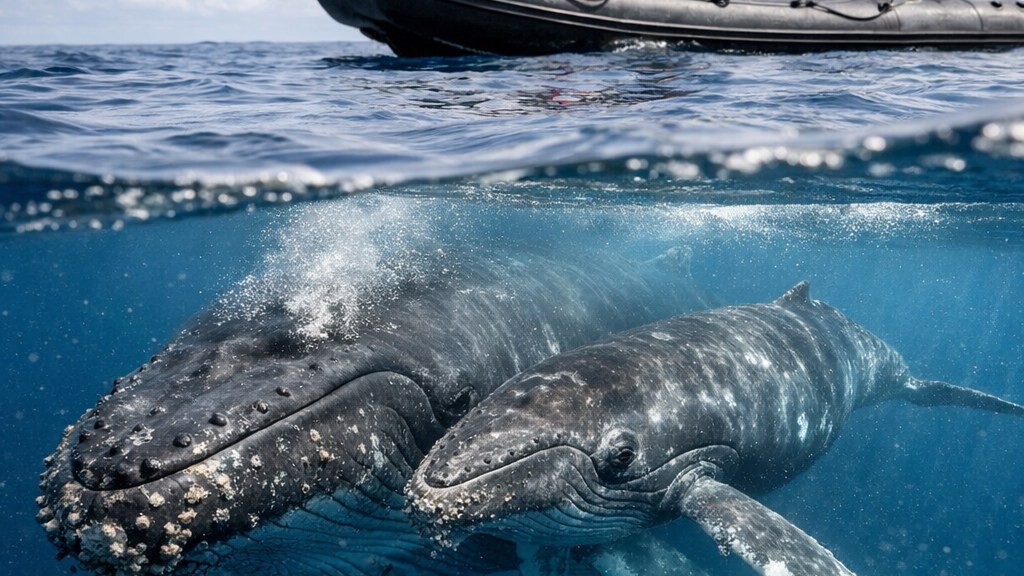
Wild whale births are rarely observed, especially in such detail. The event gave scientists a close look at coordinated care in an animal that spends much of its life far below the surface. It also showed that whale cooperation can include individuals beyond the closest kin group.
## Tools, songs and culture
Sperm whales are not the only whales changing ideas about non-human intelligence. Humpback whales are known for long, structured songs that can spread between populations. In some regions, males learn new song patterns from other whales, creating cultural change across large ocean areas.
Humpbacks also use bubbles while feeding. In bubble-net feeding, a whale releases bubbles in patterns that help trap fish or krill before lunging through the prey. Recent research has strengthened the case that some humpbacks shape these bubble nets as tools, adjusting them to make feeding more effective.
Tool use, social learning and shared songs are important because they show behavior moving through groups, not just instincts repeated by individuals. In humans, culture is central to intelligence. Whales suggest that culture can also live in the sea, carried by sound and learned behavior.
## A wider view of mind
The lesson from whales is not that they are “like humans.” It is that intelligence can take different forms. A sperm whale does not need hands to solve problems. A humpback does not need writing to pass along a song. A group does not need human words to coordinate care.
Whales also remind researchers that intelligence is shaped by environment. In the ocean, memory, listening, pressure, distance and cooperation all matter. A deep-diving animal that hunts squid, raises calves and maintains social bonds over many years faces a very different set of challenges from a land mammal.
The research also has a conservation meaning. Many whales face threats from ship strikes, fishing gear, ocean noise, pollution and climate-driven changes in prey. If whale societies depend on sound and social learning, then human noise and habitat disruption may affect more than movement or feeding. They may interfere with the social systems that help these animals survive.
Scientists are still far from speaking with whales. But they are closer to recognizing that whale intelligence is real, complex and deeply adapted to life in water. The next step is not to force whale behavior into human categories, but to understand it on its own terms.
AI Perspective
Whales show that intelligence is not one single human-shaped trait. It can be acoustic, social, cultural and deeply tied to the environment. Studying whales may help people think more carefully about other minds that share the planet.


-134c72da.webp)


-6c40e5ef.webp)

-1d29b0b2.webp)
-2721737f.webp)
-55bf1fe2.webp)
-9f154954.webp)