[[[SUMMARY_START]]]
The office is not returning to its old shape after years of hybrid work.
Companies are asking for more in-person time, but many are also redesigning space around collaboration, focus work and flexibility.
Recent workplace data show a more structured model taking hold, with hybrid work still common and office attendance concentrated in the middle of the week.
[[[SUMMARY_END]]]
After several years of uncertainty, the office is being rebuilt for a more settled but still flexible era of work. The pandemic forced a sudden remote-work experiment. The years that followed tested hybrid schedules, return-to-office rules, desk sharing and new ways to measure how space is used. In 2026, the result is not a simple return to the old five-day office. It is a different workplace with clearer rules, fewer fixed desks and a stronger focus on why people come in at all.
## Hybrid work becomes more structuredHybrid work has moved from emergency response to business policy. Many employers no longer treat it as a temporary benefit. They are writing rules for office days, team schedules and space use.
In the United States, remote-capable employees remained mostly hybrid in the second quarter of 2025. About 51% worked hybrid, 28% worked fully remote and 21% worked fully on-site. Hybrid workers averaged a little more than two days a week in the office. That pattern has been fairly stable since 2023.
The same period also showed a shift in control. Some workers still choose their own office days, but many schedules are now set by leaders, managers or teams. This has helped create a new rhythm in many city centers. Tuesday, Wednesday and Thursday are often the busiest days, while Monday and Friday remain lighter.
## More mandates, but not one model
Large employers have taken different paths. Amazon moved corporate staff toward a five-day office policy in early 2025. JPMorgan Chase also told many employees to return five days a week. Microsoft set a three-day office requirement for many workers near its Puget Sound offices beginning in 2026.
These examples show that return-to-office policies have become more formal. But they do not mean every company is choosing the same model. Some firms want five days. Others prefer three. Many are still trying to match office rules with job type, team needs, real estate costs and employee expectations.
The tension remains clear. Employers often want more face-to-face collaboration, faster training and stronger culture. Workers often value flexibility, less commuting and more control over their day. The new office is being shaped by that negotiation.
## Fewer assigned desks, more shared space
The physical office is changing as policies change. Companies are using fewer assigned desks and more shared seating. They are also studying badge data, booking systems and room use to understand when space is full and when it is empty.
Recent global workplace data show average building utilization rising to 53%, up from lower levels in 2023 and 2024. Peak use has climbed much higher, reaching about 80% in some measured portfolios. That creates a new problem. An office can feel crowded on Tuesday and underused on Friday.
To manage this, employers are adding reservation systems, neighborhood seating, phone booths, smaller meeting rooms and more flexible furniture. The old layout built around rows of individual desks is giving way to spaces for different kinds of work: focused tasks, private calls, team meetings, training, social connection and client visits.
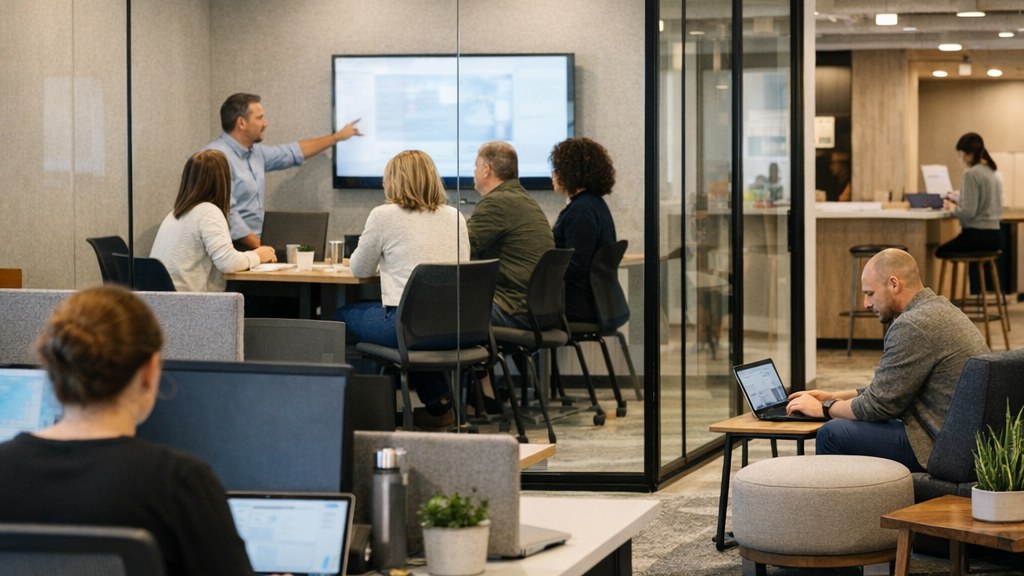
The strongest argument for the office is no longer just presence. It is purpose. Companies are trying to make office days useful enough to justify the commute.
That means more attention to design and experience. Offices are adding better meeting technology for hybrid calls, quieter focus zones, more natural light, wellness rooms, upgraded food areas and spaces that support informal conversation. In sectors such as technology, finance, law and professional services, the office is increasingly being used for mentoring, onboarding, group problem-solving and relationship building.
Younger workers are part of the discussion. Surveys in 2025 found that many Gen Z employees did not want fully remote work as much as older groups. For early-career staff, the office can offer training, visibility and social ties that are harder to build through screens alone.
## Real estate strategy is also changing
The office reinvention is not only about design. It is also about cost and footprint. Many companies are reducing or reshaping their portfolios rather than simply filling every old floor again.
Large workplace surveys show portfolio optimization has become a top goal for real estate leaders. Many firms are disposing of underused space, subletting floors, reusing furniture and trying to fit growth into existing offices. Some are investing in better spaces while giving up weaker ones.
This approach reflects a basic lesson from the hybrid experiment: companies may need the office, but they may not need the same amount of office space in the same places. The most valuable space is now the space that people use well.
## A new balance is still forming
The office after the hybrid experiment is more measured, more intentional and more contested. It is less likely to be a default place where every employee sits every day. It is more likely to be a planned environment built around specific work, shared time and company culture.
The experiment did not end with a single winner between home and office. It showed that work location depends on tasks, people, industry and management style. The next phase will be judged less by how many people come in, and more by whether office time helps them work better.
AI Perspective
The office is being redesigned because workers and employers learned different lessons from the same experiment. Flexibility proved valuable, but so did in-person connection for some kinds of work. The most successful workplaces are likely to be those that make office time clear, useful and worth the trip.


-134c72da.webp)


