[[[SUMMARY_START]]]
Digital interfaces are moving from screens into search results, glasses, cameras and everyday software.
AI summaries, personalized feeds and mixed-reality devices now decide how many people first encounter information.
The shift is changing work, media, shopping, navigation and public trust.
Governments and standards groups are responding with rules for labels, provenance and safer AI systems.
[[[SUMMARY_END]]]
Reality is not changing only because new information is being created. It is also changing because people increasingly meet the world through interfaces that filter, summarize, rank and overlay it. In 2026, this shift is visible in AI search, smart glasses, spatial computing, social platforms and computer-using agents.
## The interface is becoming the first layer of experienceFor many people, the first answer to a question no longer arrives as a list of links. It may arrive as an AI summary, a chatbot response, a short video, a map card, a recommendation feed or a visual overlay inside glasses.
This is what makes reality more interface-dependent. The same event, place or product can look different depending on the device, app, ranking system or AI model that presents it. A person searching for medical advice, a restaurant, a breaking event or a local route may see a shaped version of reality before seeing the underlying sources.
Search is a clear example. Google’s AI Overviews reached more than 1.5 billion monthly users in 2025 and expanded across about 200 countries and territories. Google Lens also shows how visual search has become normal, with more than 1.5 billion people using it monthly to search what they see. These tools turn cameras and search boxes into interpretive layers between users and the physical world.
## Wearable computing brings the layer closer
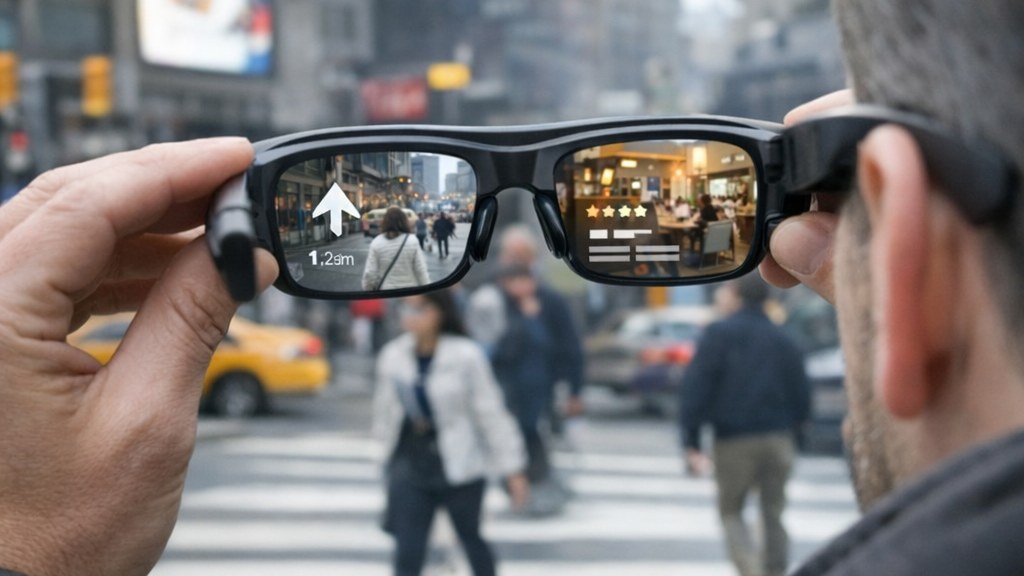
Smart glasses and spatial headsets are moving that layer from the phone to the face. Meta introduced Ray-Ban Display glasses in September 2025 with a small in-lens display and a wrist-worn neural band for control. The device was designed for short interactions such as messages, photo previews, live captions, translation and walking directions.
Apple has also continued to build around spatial computing. Its visionOS 26 update for Vision Pro added spatial widgets, shared spatial experiences and spatial scenes that use generative AI and depth techniques to give photos a more three-dimensional feel. Those features are aimed at entertainment, communication, design, training and enterprise work.
The important change is not only that information becomes more immersive. It is that the interface can decide what is visible, what is hidden and what is highlighted in a user’s field of view. A map overlay can guide attention. A caption tool can translate speech. A workplace headset can place data directly onto a machine, medical image or 3D model.
## AI agents make software less visible
Another shift is happening inside ordinary computer work. In 2025, OpenAI introduced Operator, a research preview of an AI agent that could use a browser by looking at pages and interacting with buttons, menus and text fields. The model behind it was built to work with graphical user interfaces in a way that resembles human computer use.
For businesses, this changes visibility. A company may no longer compete only for a search ranking or a social post. It may also compete to be selected, summarized or cited by an AI assistant. For users, the main question becomes whether the interface gives enough context to judge the answer.
## Trust becomes a design issue
Interface-dependent reality raises practical trust problems. AI systems can make mistakes. Social feeds can amplify some material while burying other material. Synthetic images, voices and videos can make it harder to tell whether a piece of media is authentic.
Governments and technical groups are trying to respond. The European Union’s AI Act includes transparency requirements for some AI-generated content and deepfakes. Work on labels and machine-readable marking is continuing through 2026. Technical standards such as Content Credentials aim to attach tamper-evident information about how media was made or edited.
These efforts do not remove the need for human judgment. They do show that trust is becoming part of interface design. Labels, provenance data, audit tools and clear explanations may become as important as speed and convenience.
## A shift across everyday life
The change is already broad. A driver uses a map app that ranks routes. A shopper sees products selected by a recommendation system. A student asks an AI assistant for a summary. A worker uses a headset to view instructions. A voter sees political clips through a personalized feed.
None of these examples means the physical world disappears. It means access to that world is increasingly mediated. The interface is becoming a gate, guide and editor at the same time.
The next phase of technology may therefore depend less on whether people go online and more on which interface they use to meet reality when they get there.
AI Perspective
The main lesson is that interfaces are no longer neutral containers for information. They increasingly shape attention, trust and action. The safest path is not to reject these tools, but to make their choices clearer and easier to question.


-134c72da.webp)


-6c40e5ef.webp)

-1d29b0b2.webp)
-2721737f.webp)
-55bf1fe2.webp)