[[[SUMMARY_START]]]
The next phase of the AI boom is moving beyond chatbots, search tools, and office software.
Investors and manufacturers are now focusing on robots, autonomous systems, smart factories, and machines that can act in the real world.
Recent factory pilots show progress, but the field still faces hard problems in safety, dexterity, cost, and reliability.
[[[SUMMARY_END]]]
The first wave of generative AI was built for screens. It answered questions, wrote text, made images, and helped people work faster at desks. The next wave is being aimed at the physical world, where AI is expected to guide robots, vehicles, machines, drones, and factory systems.
## From software to machinesThe phrase often used for this shift is physical AI. It describes AI systems that do not only process words, images, or code. They also sense their surroundings, plan actions, and control machines.
That makes the challenge much harder. A chatbot can make a mistake and revise an answer. A robot in a warehouse or a car plant must move safely around people, tools, shelves, and heavy parts. It must react in real time. It must also deal with dust, glare, weak wireless signals, uneven floors, and objects that are not always in the same place.
This is why the new AI race is no longer only about larger language models. It is also about sensors, chips, batteries, motors, grippers, simulation software, safety systems, and the data needed to train machines before they enter real workplaces.
## Factories are the early test bed
Factories and warehouses are becoming the clearest proving ground. They are more controlled than streets or homes. Tasks can be repeated many times. Managers can measure whether a robot is saving time, reducing strain, or improving accuracy.
The scale of existing automation is already large. Global industry installed 542,000 industrial robots in 2024, the second-highest annual total on record. More than 4.6 million industrial robots were operating worldwide by the end of that year. Asia accounted for most new deployments, with China installing far more factory robots than any other country.
The new question is whether AI can make robots more flexible. Traditional industrial robots are strong and precise, but they often need fixed positions, careful programming, and predictable work cells. Physical AI aims to give robots more perception and decision-making, so they can handle changing parts, mixed product lines, and less structured work.
BMW has provided one of the most concrete examples. At its Spartanburg plant in South Carolina, a Figure 02 humanoid robot assisted with production of more than 30,000 BMW X3 vehicles during a 2025 pilot. The robot moved more than 90,000 sheet metal parts, worked about 1,250 operating hours, and performed a task that required positioning parts for welding. BMW has also begun testing another humanoid robot, AEON, at its Leipzig plant in Germany.
## Humanoids draw attention, but not all robots need to look human
Humanoid robots attract public attention because they can work in spaces designed for people. Stairs, doors, tools, bins, and assembly stations were built around the human body. A robot with arms, legs, hands, and cameras may be able to enter those spaces without a full redesign.
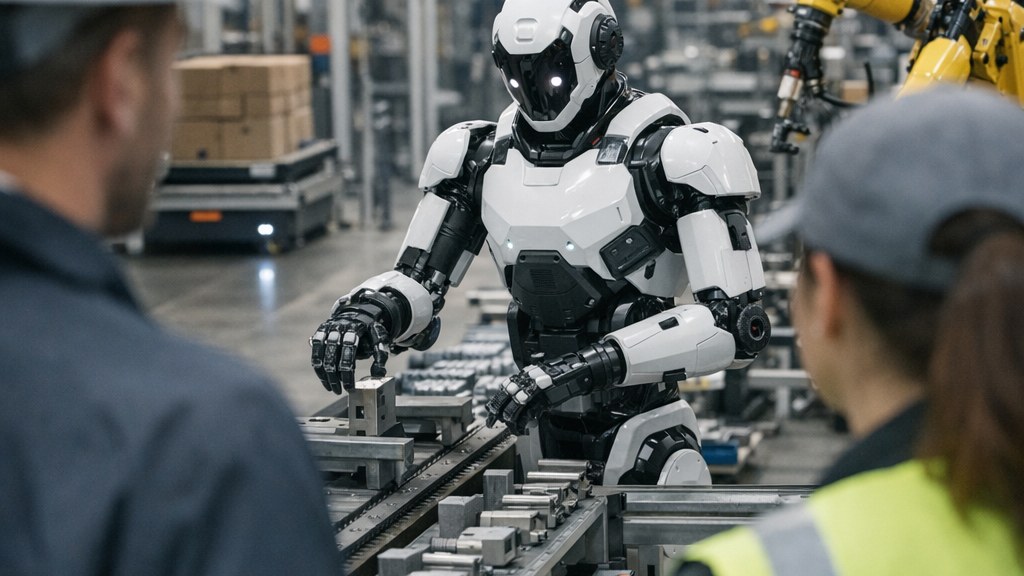
Still, the physical AI boom is not limited to human-shaped machines. Many near-term uses may come from robot arms, mobile warehouse robots, delivery systems, drones, cleaning robots, agricultural machines, inspection robots, and autonomous vehicles. In many jobs, a wheeled machine or a specialized arm may be cheaper, safer, and easier to maintain than a humanoid.
Service robots are also expanding in areas such as transportation, logistics, professional cleaning, healthcare, and agriculture. These machines may not look dramatic, but they can show where physical AI is useful now: moving goods, checking sites, cleaning large spaces, assisting hospitals, or supporting farms.
## The money is following the machines
The investment logic is easy to see. If AI can leave the screen and perform physical tasks, the possible market grows from software subscriptions into manufacturing, transport, energy, construction, health care, retail, and home services.
That has drawn capital toward companies building robot bodies, robot brains, simulation platforms, sensor systems, and edge-computing hardware. Chipmakers are also positioning themselves for a world where AI runs not only in data centers but also inside machines that need fast local decisions.
But the rush carries risk. Real-world work is slow to validate. Robots must be tested for safety. They must survive long shifts. They must justify their cost against human labor, conventional automation, and process redesign. A polished demo does not prove that a robot can work reliably for months inside a busy factory.
## A careful race with large stakes
The most likely short-term gains will come from narrow, well-defined jobs. These include moving parts, sorting packages, inspecting equipment, cleaning facilities, and assisting workers with repetitive or physically demanding tasks.
General-purpose robots that can do almost anything a person can do remain a harder goal. Dexterous hands, balance, common-sense reasoning, and safe operation around people are still difficult problems. Companies also need enough training data from real and simulated environments to make robots useful across many settings.
For now, the AI gold rush is becoming more industrial. The center of attention is shifting from prompts and screens to machines, supply chains, and workplaces. The winners may not be the companies with the flashiest robots. They may be the ones that can make physical AI reliable, safe, affordable, and useful in ordinary daily work.
AI Perspective
Physical AI shows how the AI boom is becoming more practical and more demanding. Software can scale quickly, but machines must prove themselves in places where safety, cost, and reliability matter every day. The strongest progress is likely to come from useful, narrow tasks before truly general robots become common.


-134c72da.webp)


