[[[SUMMARY_START]]]
Extreme weather is reshaping home construction in many parts of the world.
Builders are putting more focus on stronger roofs, fire-resistant materials, flood protection and heat safety.
The shift is being driven by repeated losses from hurricanes, floods, wildfires, hail and heat waves.
Costs remain a major challenge, especially for older homes and low-income families.
[[[SUMMARY_END]]]
Homes are being redesigned for a harsher climate. In many places, the old goal was to keep rain out, hold heat in, and meet basic local codes. Today, builders are also thinking about wind, floodwater, wildfire embers, hail, extreme heat and long power outages.
## Stronger roofs and wallsThe roof has become one of the most important parts of a climate-ready home. In hurricane, tornado and hail-prone areas, builders are using stronger roof decks, better fasteners and sealed roof layers that help keep water out if shingles are damaged.
A sealed roof deck is a simple idea. If the outer roof covering fails, a second barrier can reduce rain entering the attic and walls. That can limit mold, ceiling collapse and interior damage after a storm.
In high-wind areas, builders are also paying more attention to the “continuous load path.” This means tying the roof, walls, floors and foundation together so wind forces move through the whole structure instead of tearing one part away. Stronger garage doors, impact-rated windows and storm shutters are also becoming more common in coastal communities.
Voluntary standards such as FORTIFIED Home have grown because they go beyond minimum code in some areas. The 2025 standards cover hazards including high wind, wind-driven rain and hail. They are used for new homes and for some roof replacements.
## Building for fire before the fire arrives
Wildfire risk is changing home design in the West, parts of Canada, Australia and other fire-prone regions. The main danger is not only direct flame. Windblown embers can travel ahead of a fire and enter vents, gutters, decks or small gaps.
That is why fire-resistant design often begins with the outside shell of the house. Builders are using Class A roofs, noncombustible siding, tempered glass, enclosed eaves and ember-resistant vents. Decks and fences are also being reconsidered because they can carry fire to a wall.
The area closest to the home is now treated as part of the building system. California fire guidance highlights a 0-to-5-foot ember-resistant zone around structures. That means removing dry leaves, wood piles, mulch and other materials that can ignite beside walls or windows.
The lesson is clear: a fire-resilient home is not just a stronger house. It is a house, yard and neighborhood designed together.
## Flood protection moves upward
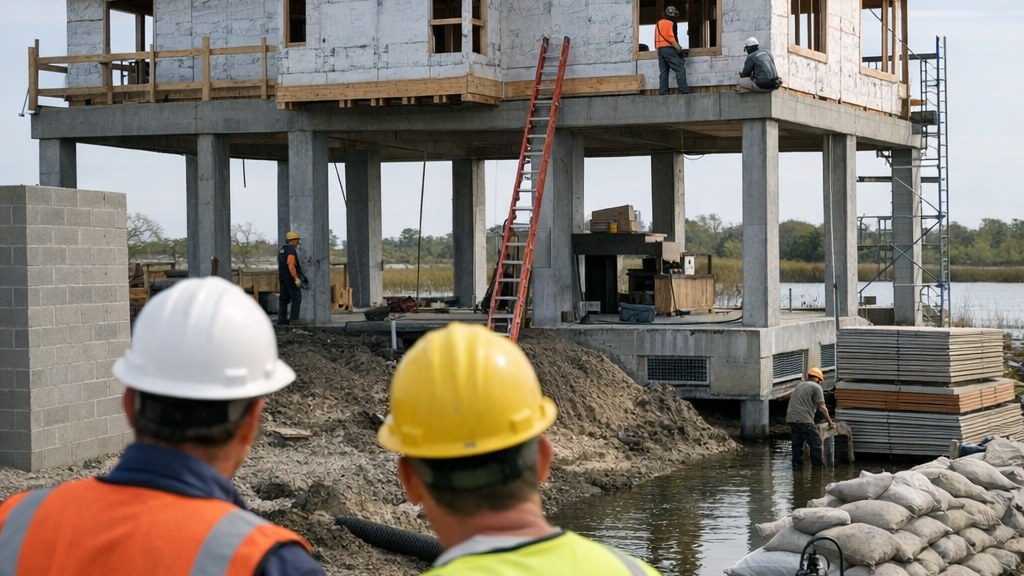
Flood-ready building often means moving living space, wiring, heating systems and air-conditioning equipment above expected flood levels. In many flood zones, homes are elevated on piers, piles or raised foundations. Enclosed spaces below may use flood openings so water can flow in and out instead of pushing against walls.
Materials are changing too. Below flood levels, builders may use concrete, tile, pressure-treated wood, closed-cell insulation or other flood-damage-resistant materials. The goal is not to make a home waterproof. In many floods, that is not realistic. The goal is to reduce structural damage and make cleanup safer and faster.
## Heat is now a design risk
Extreme heat is also changing home construction. A house that depends only on air conditioning can become dangerous during a long outage. Designers are adding features that slow indoor heating and reduce cooling demand.
These include better insulation, tighter air sealing, shaded windows, reflective or “cool” roofs, ventilation strategies, ceiling fans and high-efficiency heat pumps. In some homes, solar panels and batteries provide backup power for cooling, refrigeration and medical devices.
Passive design is receiving more attention. A home that uses shade, orientation, roof color and airflow well can stay safer for longer during a heat wave. This matters most for older adults, children and people with health conditions.
## Codes, insurance and cost
Modern building codes are one of the main tools for reducing disaster losses. Federal modeling has found that hazard-resistant codes can prevent large property losses over time. A national mitigation study also found that adopting modern model building codes can save many dollars in future disaster costs for every dollar invested.
But the shift is uneven. Codes vary by state, city and county. Some places update quickly after major disasters. Others move slowly because of cost concerns, politics or limits on local enforcement.
The biggest problem is the existing housing stock. Most homes that will face the next storm, fire or heat wave have already been built. Retrofitting them can be expensive. Roof upgrades, flood elevation, ember-resistant vents, drainage work and backup power may be out of reach for many owners.
Insurance pressure is also shaping decisions. In some high-risk areas, premiums have climbed or coverage has become harder to find. That is pushing more homeowners, builders and local officials to look at resilience as a basic part of housing, not an optional upgrade.
Extreme weather is not producing one new kind of home. It is producing many local answers. A Gulf Coast home may focus on wind and flood. A California foothill home may focus on embers and defensible space. A city apartment may focus on cooling and backup power.
The common idea is the same: homes are being built not only for normal days, but for the worst days they are likely to face.
AI Perspective
The change in homebuilding shows that resilience is becoming part of everyday design. Stronger homes can reduce damage, but they also raise questions about cost and fairness. The next challenge is making safer construction available not only in new developments, but also in older neighborhoods that face the same risks.


-134c72da.webp)


