[[[SUMMARY_START]]]
Satellites are playing a larger role in climate work, from tracking methane leaks to measuring greenhouse gases and water cycles. At the same time, the fast growth of space activity is raising pressure to reduce debris and design cleaner missions. New missions, rules and servicing plans show how sustainability is becoming a core part of the space sector.
[[[SUMMARY_END]]]
Space is increasingly being used to support sustainability goals on Earth. New satellites can spot methane leaks, track greenhouse gases, and monitor water systems at a global scale. But the push for a greener future now reaches beyond Earth as well, as agencies and companies try to limit debris and make space operations more responsible.
Space technology is becoming a practical part of the sustainability agenda.For years, Earth observation satellites have helped scientists study forests, oceans, ice, storms and crop conditions. Now a newer generation of missions is going further. They are designed to measure greenhouse gases more precisely, identify major pollution sources, and support climate policy with data that is broader and more frequent than many ground systems can provide.
That work has advanced quickly over the past two years. Japan launched GOSAT-GW in June 2025, adding a new satellite to its long-running greenhouse gas monitoring effort. The mission is built to observe both greenhouse gases and the water cycle, linking climate and weather-related data in one platform.
Another important step came with Tanager-1, launched in August 2024. The satellite is designed to detect methane and carbon dioxide emissions at high resolution, including emissions from individual facilities. That matters because methane is a powerful greenhouse gas, and cutting leaks from oil, gas and waste systems is often seen as one of the fastest ways to slow warming in the near term.
MethaneSAT, another high-profile effort, launched in March 2024 but lost contact in June 2025. Even so, the mission helped show the growing interest in satellites that can detect and compare emissions across large regions. The broader field has continued to expand, with public and private systems working toward more complete and more detailed emissions maps.
## Watching emissions from above
The value of these missions is not only scientific. They also support verification.
Governments are under pressure to report emissions more accurately under international climate agreements. Businesses also face rising scrutiny over methane leaks, flaring and carbon claims. Space-based measurements can help close some of the gaps between reported figures and real-world conditions.
Europe is preparing a major next step through its Copernicus CO2M mission, with the first satellite planned for launch in 2027. The mission is intended to monitor carbon dioxide, methane and nitrogen dioxide, and to help separate human-caused emissions from natural fluxes when combined with models and ground observations.
This points to a wider shift in how satellites are used. They are no longer just collecting images of Earth. They are becoming part of environmental accounting, disaster planning, water management and industrial monitoring.
Farmers use satellite data to track drought stress and crop health. Cities use it to watch heat, land use and flooding risk. Emergency agencies rely on it during wildfires, storms and oil spills. In that sense, space infrastructure now supports many of the systems that countries depend on to manage environmental risk.
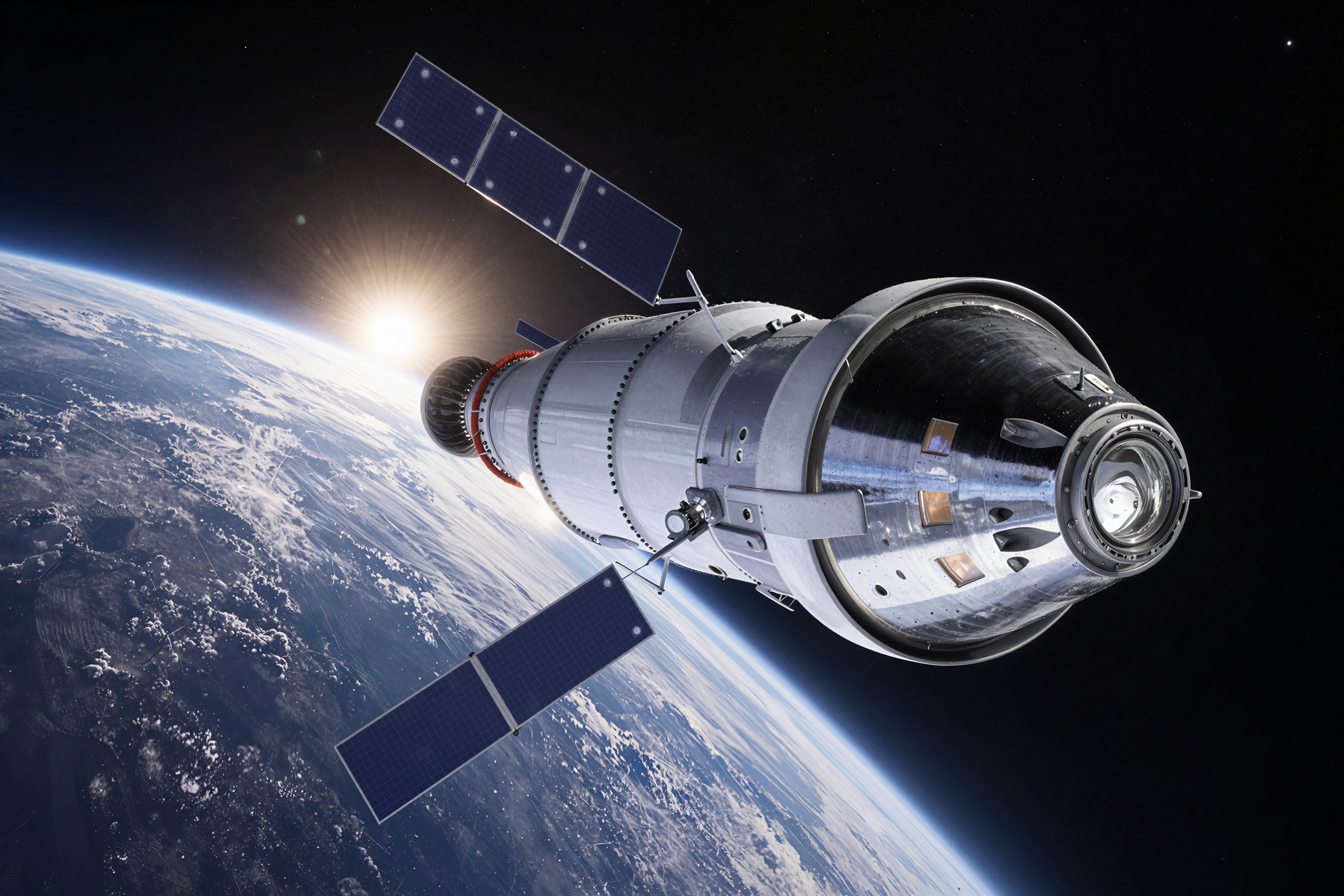
Yet the sector faces a clear contradiction. Space helps monitor sustainability on Earth, but space activity itself creates environmental and safety challenges.
The most urgent is orbital debris. Thousands of satellites and fragments already move through crowded orbital paths, especially in low Earth orbit. Even small pieces can damage spacecraft because they travel at very high speed. As more launches take place, the long-term safety of the orbital environment has become a central policy issue.
Space agencies are now treating debris reduction as part of sustainability, not just a technical side problem. The United Nations has long-term sustainability guidelines for outer space activities. In Europe, the European Space Agency is pushing a Zero Debris approach, with the goal of sharply limiting debris from future missions by 2030.
This shift is starting to affect spacecraft design. Engineers are working on satellites that can leave orbit more safely at the end of their lives, burn up more completely during reentry, or be serviced rather than abandoned. Active debris removal is also moving from concept to early commercial work. In January 2026, the U.S. Space Force awarded a contract for an end-of-life satellite disposal service, a sign that debris removal may become a real market and not only an experimental idea.
The same logic applies to in-orbit servicing. If satellites can be repaired, refueled or guided safely out of orbit, operators may be able to reduce waste and extend mission life. That could make space systems both cheaper and more sustainable over time.
## A sector learning to measure its own impact
The larger lesson is simple. Space is no longer separate from sustainability debates. It sits inside them.
Satellites are helping the world measure emissions, track climate change and manage natural resources. At the same time, the industry is being asked to reduce its own footprint, protect shared orbits and plan for the full life cycle of spacecraft.
That dual task is likely to shape the next phase of the space economy. Success will depend not only on launching more hardware, but on building systems that are useful, durable and responsible from start to finish.
AI Perspective
This topic shows that space technology now has two sustainability jobs. It helps people understand what is happening on Earth, and it must also become safer and cleaner in orbit. The most durable progress will likely come from treating those two goals as part of the same system.


-134c72da.webp)


-6c40e5ef.webp)