[[[SUMMARY_START]]]
Cooking was one of the earliest human technologies, and it may have helped change the course of evolution.
By making food softer, safer, and richer in usable energy, it gave early humans a better way to fuel larger brains.
The evidence points to a long process involving fire, tools, meat, fish, starch-rich plants, and social cooperation.
[[[SUMMARY_END]]]
The human brain is powerful, but it is costly. In adults, it makes up only a small share of body weight while using about a fifth of the body’s resting energy. That high demand has shaped one of the central questions in human evolution: how did our ancestors get enough fuel to support such a large brain?
## Food as an early technologyCooking is often treated as a daily habit, but in human history it was also a major technology. Long before farming, writing, or cities, early humans learned to change food with tools, fire, pounding, cutting, and heat.
Those changes mattered. Raw food can be hard to chew and digest. Heat softens tough plant fibers and animal tissue. It helps break down starches and proteins. It can also kill many parasites and disease-causing microbes.
That does not mean cooking alone created the modern human brain. Scientists still debate the timing and the exact causes. But many lines of research point in the same direction: better food made bigger brains more possible.
## A hungry organ needed better fuel
The brain is an expensive organ. Modern humans have large brains compared with body size, and those brains need a steady supply of energy.
Over millions of years, human brain size increased greatly. The change was not smooth or simple. It happened in different human species, in different environments, and under different pressures. But the broad pattern is clear. Early members of the human family had smaller brains than later species such as Homo erectus, Neanderthals, and Homo sapiens.
By about 1.9 million years ago, Homo erectus had appeared. This species had a larger braincase than earlier hominins, a more human-like body shape, and the ability to travel long distances. Around the same broad period, stone tools became more advanced. Tools helped early humans cut meat, crack bones, process plants, and reduce the work of chewing.
Food quality may have been central to this shift. Meat and marrow offered dense calories and important nutrients. Fish added protein and fats. Tubers and other starchy plants could become far more useful when cooked. A more flexible diet helped early humans survive in changing climates and different habitats.
## What cooking changed
Cooking can act like a first stage of digestion. It makes many foods easier for the body to use. A cooked tuber, for example, can release more usable starch than a raw one. Cooked meat can become softer and easier to chew. Heat can reduce some digestive costs and make meals safer.
This would have had practical effects. Early humans could spend less time chewing. They could gain more energy from the same amount of food. They could eat items that were too tough, toxic, or risky in raw form.
These gains may have helped support changes seen in the human body. Compared with other great apes, humans have smaller teeth, smaller jaws, and a shorter digestive system for body size. Those traits fit a diet that had become softer and easier to process.
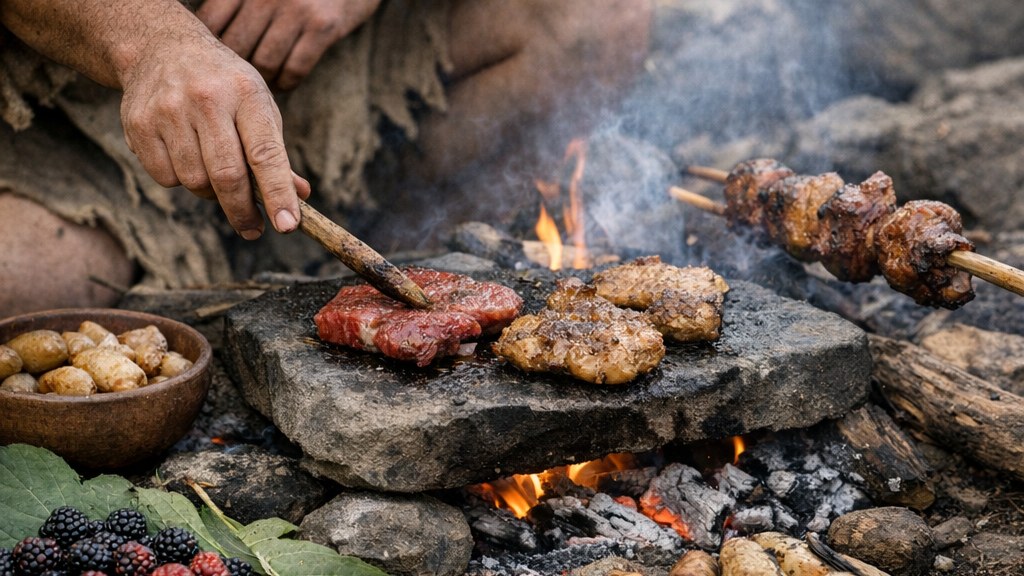
The safest conclusion is that human brain evolution did not come from one cause. Cooking was likely part of a larger food revolution.
## Clues from ancient sites
Direct evidence of very early cooking is hard to find. Fire leaves traces, but those traces can be destroyed or confused with natural burning. Archaeologists must look for burned sediments, hearths, heated stones, altered bones, plant remains, and microscopic changes in food remains.
One important site is Gesher Benot Ya’aqov in the Jordan Valley, dated to about 780,000 years ago. Researchers studied ancient fish remains from the site and found evidence consistent with controlled heating rather than simple burning. The site has been widely discussed as one of the earliest strong signs that ancient humans cooked food.
Other finds show that ancient humans used fire in different ways over long periods. Evidence from sites in Africa, Europe, and the eastern Mediterranean suggests that fire became more common and better controlled through time. More recent work on a roughly 400,000-year-old site in eastern England has added evidence for deliberate fire-making by ancient humans.
These discoveries do not prove that cooking began at one exact date. They show that fire use and food processing developed over a long span.
## A social change as well as a diet change
Cooking also changed behavior. A fire creates a gathering place. Cooked meals take time. Food may need to be collected, guarded, shared, and divided.
That could have encouraged cooperation. It may have helped shape daily routines, group bonds, and learning between generations. Young people could watch older people prepare food, choose safe plants, handle meat, and manage fire.
In that sense, cooking was more than a way to feed the body. It was a way to organize life.
The human brain did not grow simply because food tasted better. It grew in a world where ancestors found new ways to get energy, reduce risk, work together, and adapt. Cooking and better food gave that process a powerful boost.
AI Perspective
The story of cooking shows how technology can begin with a simple act. A controlled fire and a prepared meal may have changed the body, the brain, and social life over many generations. The lesson is that human intelligence was built not only in the head, but also around food, tools, and shared daily work.


-134c72da.webp)


-6c40e5ef.webp)
