[[[SUMMARY_START]]]
Future conflict in orbit is likely to be slow, technical and driven by software, not fast turns by piloted spacecraft.
Colorado-based True Anomaly is building Jackal spacecraft and Mosaic software for military space operations.
The company has also been selected for U.S. Space Force work on space-based interceptors tied to the Golden Dome missile-defense plan.
Its growth shows how fast private space defense firms are moving into a once mostly government-led field.
[[[SUMMARY_END]]]
Space combat, if it ever happens, will not look like a movie scene. There will be no pilots banking through the stars at close range. The more likely picture is colder and slower: satellites changing orbits, tracking targets, conserving fuel and using software to decide when and where to move.
True Anomaly, a Colorado-based defense space company founded in 2022, is trying to build for that future. Its main products are Jackal, a maneuverable autonomous orbital vehicle, and Mosaic, a software platform designed to plan and control space missions.The company describes Jackal as a multi-role spacecraft for contested space environments. It is built to move in orbit, carry sensors or other payloads, and support missions such as inspection, surveillance, training and response. Mosaic is meant to help operators manage spacecraft and other assets from the ground, with humans still in control of key decisions.
## Why space combat is different
A fight in orbit would be shaped by orbital mechanics. Satellites travel at very high speeds, but they cannot simply stop, turn around or chase each other like aircraft. A spacecraft must spend fuel to change its path. Even small changes can take time to produce the desired position.
That makes timing, prediction and awareness central. A close approach between spacecraft could be planned hours or days in advance. The important questions would be where an object is going, what it can see, how much fuel it has, and whether its movement is normal or threatening.
This is why companies working in the field focus heavily on rendezvous and proximity operations, space domain awareness, command software and autonomy. The “dogfight” is less about a dramatic chase and more about who understands the orbital picture first and can act with precision.
## True Anomaly’s growing role
True Anomaly has moved quickly. The company has launched Jackal spacecraft into low Earth orbit and has announced plans to send Jackal vehicles to geosynchronous orbit and cislunar space in 2026. Geosynchronous orbit is important because many military and commercial communications satellites operate there. Cislunar space, the region between Earth and the Moon, is becoming a greater focus as governments and companies plan more lunar activity.
The company has also been involved in the U.S. Space Force’s Victus Haze mission, a tactically responsive space demonstration. That effort is designed to show how military and commercial teams could rapidly launch and operate satellites to respond to activity in orbit.
In April 2026, True Anomaly announced a $650 million Series D financing round. The company said the round pushed its total capital raised past $1 billion since its founding. It also said it planned to more than double its headcount from about 250 employees at the end of 2025 to more than 500 by the end of 2026, and to more than 1,000 by 2028.
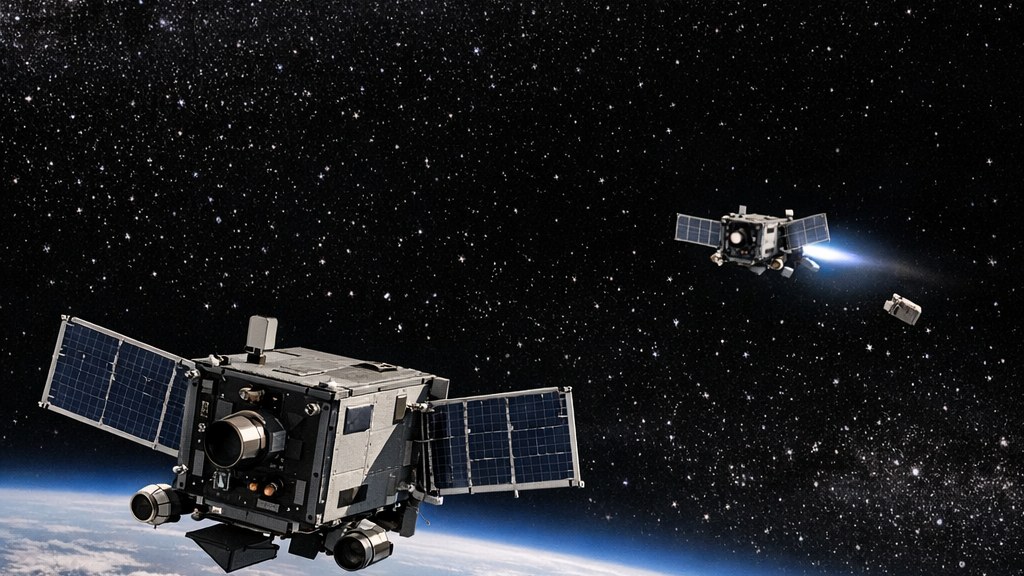
The company’s ambitions now extend beyond satellite maneuvering. In May 2026, True Anomaly announced that it had been selected to take part in the U.S. Space Force Space-Based Interceptor program.
That program is part of the planned Golden Dome for America missile-defense architecture. The Space Force has said the goal is to develop space-based systems that can help intercept missile threats, including advanced hypersonic weapons, during different phases of flight.
The Space Force awarded 20 agreements with a combined potential value of up to $3.2 billion to 12 companies in late 2025 and early 2026. The named companies are Anduril Industries, Booz Allen Hamilton, General Dynamics Mission Systems, GITAI USA, Lockheed Martin, Northrop Grumman, Quindar, Raytheon, Sci-Tec, SpaceX, True Anomaly and Turion Space.
The service has said it wants to demonstrate an initial capability integrated into the Golden Dome architecture by 2028. Many technical details remain limited. The challenge is large because a useful system would need reliable tracking, fast decision-making, precise interceptors, secure communications and enough spacecraft to cover wide areas.
## A shift in the space industry
True Anomaly is part of a wider change in the space sector. For decades, military space systems were mainly built by large traditional defense contractors. Newer firms are now trying to bring faster production cycles, venture funding and commercial-style software development into national security space work.
This does not mean space combat is near or inevitable. It does mean governments are preparing for a more contested orbital environment. Satellites support navigation, communications, missile warning, weather data, financial timing and military operations. Protecting them has become a more visible part of defense planning.
For now, the company’s work is still measured in tests, demonstrations, contracts and planned missions. But the direction is clear. The future of conflict in space, if it comes, will be decided less by cinematic maneuvers and more by sensors, software, orbital math and the ability to move at the right moment.
AI Perspective
The story shows how space is becoming a more active security domain, even as the technology remains difficult and largely unproven at scale. The most important developments may not look dramatic from Earth, but they could shape how satellites are protected and controlled. Clear rules, careful testing and transparency will matter as these systems move from concept to operation.


-134c72da.webp)


