[[[SUMMARY_START]]]
Kīlauea remains in an active, on-and-off summit eruption that began in December 2024.
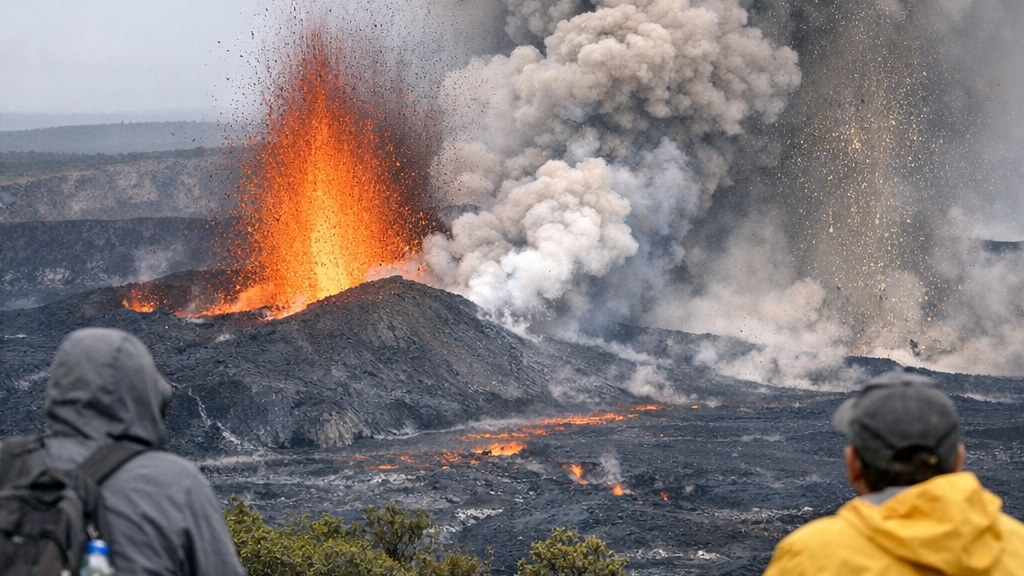
Recent episodes have sent lava fountains hundreds of feet into the air and carried ash, Pele’s hair and other volcanic fragments beyond the crater rim.
The latest completed episode ended on May 15 after about nine hours, while monitoring showed signs that another episode could follow in late May.
[[[SUMMARY_END]]]
Kīlauea, one of the world’s most closely watched volcanoes, is continuing a restless pattern at its summit on the Island of Hawaiʻi. The eruption remains centered in Halemaʻumaʻu crater, inside Kaluapele, the volcano’s summit caldera, where repeated bursts of lava fountaining have built fresh layers of black basalt and sent ash-bearing plumes over parts of Hawaiʻi Volcanoes National Park and nearby communities.
## A summit eruption with repeated burstsKīlauea’s current summit eruption began on December 23, 2024. Since then, activity has not been steady. Instead, the volcano has produced separate episodes of lava fountaining from vents in Halemaʻumaʻu.
These episodes often last less than 12 hours. They are separated by pauses that can last days or, at times, more than three weeks. During a pause, glow may still be visible at the vents, and gas can continue to escape from the summit area.
The most recent completed episode, episode 47, began on May 14 and ended just after midnight on May 15, Hawaiʻi time. It lasted about nine hours. Lava fountaining came from the north vent and reached about 650 feet, or 200 meters, above the vent. An estimated 6.8 million cubic yards, or 5.2 million cubic meters, of lava erupted during that episode.
The lava remained confined to the summit area. No homes were threatened by lava flows. But the eruption still created hazards beyond the crater because hot fountains can shred lava into glassy volcanic fragments.
## Ash and glassy fragments travel with the wind
The material thrown into the air is known as tephra. It can include fine ash, pumice, scoria, reticulite and thin strands of volcanic glass known as Pele’s hair. Larger pieces fall close to the vents. Smaller fragments can travel much farther, depending on wind speed and direction.
During episode 47, the plume rose to about 20,000 feet, or 6,000 meters, above sea level. Fine ash and Pele’s hair fell in communities northeast of the park, including Mauna Loa Estates, ʻŌhiʻa Estates, Volcano Village and Royal Hawaiian Estates. Sparse pieces of reticulite up to about 3 inches, or 5 centimeters, were recorded at Uēkahuna and Keanakākoʻi overlooks.
A stronger earlier burst on March 10 showed how quickly conditions can change. That episode produced some of the tallest fountains of the current eruption, with estimates as high as 1,770 feet, or 540 meters. Ash and volcanic fragments spread across summit areas, prompting temporary closures inside Hawaiʻi Volcanoes National Park and affecting Highway 11.
Other recent episodes also sent material outside closed areas. On May 5, episode 46 produced fountains about 650 feet high and a plume near 20,000 feet above sea level. Fist-sized and smaller fragments fell along the north rim of Kaluapele and on parts of Highway 11. Uēkahuna and Kīlauea overlooks were temporarily closed.
By late May, the eruption was paused, but monitoring showed that the summit was inflating again. Inflation means pressure is building beneath the summit, often because magma is moving or accumulating underground.
Forecast models suggested that episode 48 could occur between Sunday, May 24, and Wednesday, May 27. Such forecasts can shift as new data arrive. Scientists watch ground tilt, earthquakes, tremor, gas emissions and webcam views to track changes in the vents.
No significant activity had been noted along Kīlauea’s East Rift Zone or Southwest Rift Zone in the latest monitoring updates. The main activity remained at the summit.
## Hazards remain local but serious
The eruption is occurring inside a closed area of Hawaiʻi Volcanoes National Park. Lava flows during this eruptive sequence have stayed in Halemaʻumaʻu crater and the southwest side of Kaluapele.
The main public hazards are volcanic gas, ash, Pele’s hair and unstable ground near the caldera. Sulfur dioxide from the volcano can form vog, a volcanic haze that may affect people with breathing problems. Tephra can irritate skin, eyes and lungs. It can also make roads slippery when it covers pavement or is stirred up by wind and traffic.
Park areas have reopened and closed at different times as conditions changed. Visitors are urged to follow official closures, avoid closed crater-rim areas and check current park conditions before traveling to viewpoints.
Kīlauea has long been one of Hawaiʻi’s most active volcanoes. The current pattern is dramatic but closely monitored. For residents and visitors, the key message is simple: lava may be confined to the crater, but ash, gas and glassy fragments can still reach places people use.
AI Perspective
Kīlauea’s latest activity shows how a contained summit eruption can still affect nearby roads, communities and park access. The lava is visually striking, but the quieter hazards, such as ash, vog and Pele’s hair, matter just as much for public safety. Careful monitoring gives people time to prepare, but conditions around an active volcano can change quickly.


-134c72da.webp)


