[[[SUMMARY_START]]]
Recent surveys point to a growing challenge in public life: people have more information, but fewer shared places to test it.
Trust is moving away from large institutions and toward smaller personal circles.
At the same time, young adults report more stress, weaker social ties and lower well-being than older groups.
The result is a more fragmented search for meaning, not a single crisis with one cause.
[[[SUMMARY_END]]]
Meaning is becoming harder to anchor in many societies because the old reference points are shifting at the same time. Institutions are less trusted. Online information is faster and harder to verify. Religious and civic identities are changing. Younger people are reporting more strain in their daily lives.
## A weaker shared frameRecent global surveys show that trust is becoming more personal and less institutional. A 2026 trust survey across 28 countries found that people now place more confidence in those close to them, such as family, friends, neighbors and coworkers, while trust in national leaders and large information institutions has weakened.
The same survey found that inflation, misinformation, the COVID-19 pandemic, trade tensions and the spread of generative AI were among the main events shaping trust over the past five years. These pressures do not affect every country or community in the same way. But together they have made it harder for people to agree on which institutions can explain events fairly.
Global risk assessments also place misinformation, disinformation and social polarization near the top of near-term concerns. These are not only political problems. They affect daily life. When people cannot agree on basic facts, it becomes harder to form a shared story about work, family, public duty or the future.
## Information is everywhere, but certainty is harder
The information environment has changed quickly. In the United States, recent polling found that 56% of adults say they have at least some trust in information from national news organizations, while 70% say the same about local news. Trust in information from social media is lower overall, but among adults under 30, trust in national news and social media is now almost even.
That shift matters because younger people are often building their sense of the world in spaces where news, entertainment, advertising, personal advice and automated content appear side by side. Short videos, influencer posts, AI summaries and chatbots can make information feel immediate and personal. They can also blur the line between evidence, opinion and performance.
Research on online misinformation shows that many people are not as good at spotting false or misleading content as they believe. In one cross-country test, users correctly identified true and false claims about 60% of the time. The same research found that confidence in one’s own judgment did not reliably match actual ability.
AI adds another layer. General-purpose AI tools can help users write, search, translate and learn. They can also generate convincing text, images and audio. This makes verification more important, especially during elections, crises, health scares and conflicts.
## Old anchors are changing
For much of modern life, meaning was often shaped by a mix of family, religion, work, nation, school, local community and shared media. Those anchors still matter. But they are less uniform than they once were.
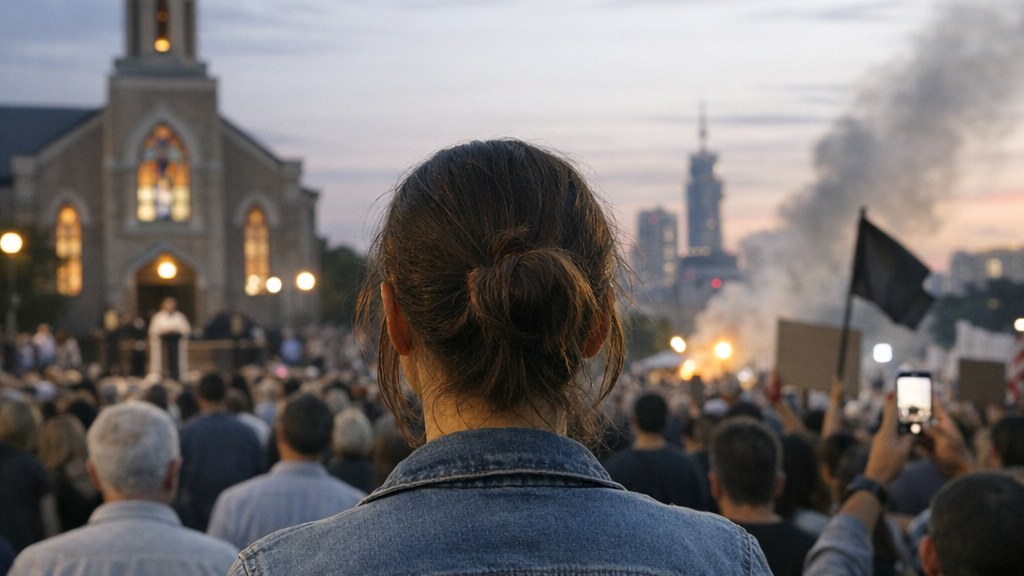
This does not mean people have stopped seeking purpose. Many still find it in faith communities. Others look to friendships, careers, activism, parenting, creative work, fitness, online groups or local service. The change is that fewer people are drawing meaning from the same shared institutions at the same time.
Work is also less stable as a source of identity for many people. Inflation, layoffs in some sectors, remote work, automation and changing career paths have made the link between job, status and life purpose less predictable. For some workers, flexibility has opened new possibilities. For others, it has weakened daily routines and social bonds.
## Younger adults feel the strain
The search for meaning is especially visible among younger adults. Recent U.S. polling found that 36% of adults under 30 rate their mental health as fair or poor. Only about one in five say they are managing stress very well. About four in ten say they are doing very well at maintaining good relationships with other people, a lower share than among older adults.
Global well-being research has also found that young people in North America and Western Europe are much less happy than they were 15 years ago. Social media is often discussed as one possible factor, but researchers continue to study the relationship carefully. The evidence points to a complicated picture, not a single cause.
Teen surveys show that many young users say major social platforms neither help nor hurt their self-esteem or mental health. At the same time, some report problems with sleep, productivity and time spent online. These mixed findings reflect the broader reality: digital life can connect people, but it can also crowd out rest, attention and face-to-face support.
## Meaning is becoming more local
The clearest trend is not that meaning has disappeared. It is that people are anchoring it closer to home. Family, friends, neighbors, coworkers and smaller communities are becoming more important as national and global institutions struggle to hold trust.
This creates both risk and resilience. Smaller circles can provide care, identity and belonging. But if those circles become closed off from one another, societies may find it harder to solve shared problems.
The task ahead is practical. People need trusted local ties, better information skills, transparent institutions and spaces where disagreement does not become separation. Meaning may be harder to anchor now, but it is still built through connection, trust and shared responsibility.
AI Perspective
The search for meaning is moving from large shared systems toward smaller circles of trust. That can help people feel supported, but it can also make societies more divided if those circles do not overlap. A healthier public life may depend on rebuilding places where people can test facts, disagree safely and still feel connected.


-134c72da.webp)


