[[[SUMMARY_START]]]
Governments, companies and communities are facing a world where shocks move quickly across borders and systems.
Artificial intelligence, cyber risk, war, trade tension and climate stress are testing old forms of control.
Recent 2026 risk data shows that resilience, coordination and trust are becoming more important than command alone.
[[[SUMMARY_END]]]
Control is not disappearing. But in 2026, it is becoming harder to hold. From artificial intelligence systems that act on their own, to cyberattacks that can spread through shared infrastructure, to wars and climate events that disrupt daily life far beyond their starting point, the world is learning a difficult lesson: many systems now move faster than the institutions built to manage them.
## A risk map shaped by confrontationThe clearest sign is the global risk outlook. A major 2026 survey of more than 1,300 leaders and experts ranked geoeconomic confrontation as the top risk for this year. State-based armed conflict came next, followed by extreme weather, societal polarization, and misinformation and disinformation.
That list shows a shift in the meaning of control. Power is no longer only about armies, borders or laws. It is also about supply chains, energy routes, software, finance, public trust and the flow of information.
Half of the surveyed experts expected the next two years to be turbulent or stormy. Only a very small share expected calm. That does not mean disorder is certain. It does mean that decision-makers are planning for a world where shocks are more connected and less predictable.
The same pattern appears in diplomacy. The wars in Ukraine, the Middle East and Sudan continue to test international institutions. In Ukraine, verified civilian casualties in the first four months of 2026 were higher than in the same period of 2025. Large missile and drone attacks in May added to concerns about escalation and miscalculation.
## AI is testing human oversight
Artificial intelligence has become one of the strongest examples of this new control problem. AI tools can help detect fraud, write code, manage information and support cyber defence. But the same speed and scale can also make oversight harder.
In 2026, 94% of cyber leaders in a global survey identified AI as the most significant driver of change in cybersecurity. Another 87% identified AI-related vulnerabilities as the fastest-growing cyber risk over the previous year.
The concern is not only about powerful future systems. It is already practical and immediate. Companies are adding AI agents that can search files, use business software, write messages, make recommendations and, in some cases, take actions across systems.
That creates a basic question: who is responsible when a semi-autonomous system makes a bad decision, exposes data or follows a malicious instruction? Recent enterprise analysis predicts that by 2027, 40% of enterprises may demote or decommission autonomous AI agents because governance gaps are found only after real incidents.
The issue is not whether AI should be used. It is whether organizations can give each system the right level of permission, monitoring and human review. Too much restriction can drive workers to unapproved tools. Too little can create security, legal and operational risks.
## Cyber risk has become systemic
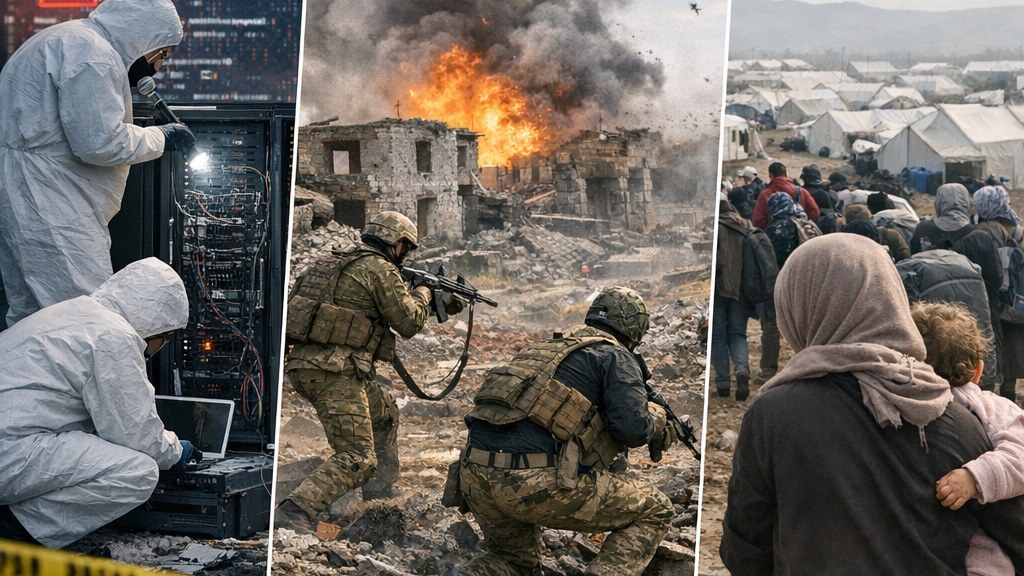
That makes cyber risk more like a system-wide stability issue. Financial officials have warned that severe cyber incidents could trigger funding strains, raise solvency concerns and disrupt markets. AI can reduce the time and cost needed to find and exploit software weaknesses, which increases the risk that the same vulnerability could be targeted across many organizations at once.
This is why control now depends less on perfect prevention and more on resilience. Backups, stress tests, incident drills, clear accountability and fast recovery plans are becoming as important as firewalls.
## Climate shows the limits of command
Climate data adds another layer. The year 2025 was the second or third warmest year on record, at about 1.43 degrees Celsius above the 1850-1900 average. Ocean heat content reached the highest level in a 66-year observational record. Global mean sea level remained near record highs, with the rate of rise from 2012 to 2025 much faster than from 1993 to 2011.
These figures matter because climate risk does not stay in one category. Heat affects health and power demand. Floods damage roads and housing. Drought can strain food systems. Stronger and more frequent extremes can force insurers, city planners, farmers and emergency services to rethink what is manageable.
Human displacement shows the social side of the same pressure. The most recent mid-2025 global figures put the number of forcibly displaced people at 117.3 million. The total reflected conflict, violence, persecution, human rights violations and events that seriously disturb public order.
## Control is changing, not ending
The lesson from these risks is not that institutions are powerless. Governments still regulate. Companies still manage. Communities still prepare and recover.
But control now looks less like issuing an order and more like building systems that can absorb shocks. It means knowing where dependencies are hidden. It means testing plans before a crisis. It means keeping humans responsible when machines act faster than humans can watch.
The idea of total control may be fading. The need for careful, accountable control is growing.
AI Perspective
The main takeaway is that modern risk is connected. A failure in one area can quickly affect finance, politics, technology or daily life. The strongest response is not panic, but steady work on resilience, transparency and human accountability.


-134c72da.webp)


-6c40e5ef.webp)

-1d29b0b2.webp)
-2721737f.webp)
-55bf1fe2.webp)
-9f154954.webp)