[[[SUMMARY_START]]]
Daily life in much of the world can still look normal, but major systems are under pressure.
Trade is moving, economies are growing and technology is advancing.
At the same time, war, climate stress, debt, cyber risk and political distrust are testing that stability.
[[[SUMMARY_END]]]
The world in mid-2026 does not look like a system in collapse. Planes are flying, markets are open, supply chains are still moving and most governments are functioning. Yet many of the structures behind that normal life are more strained than they appear.
## A steady surfaceGlobal life still carries many signs of resilience. The world economy is expected to grow in 2026, though at a slower pace than in earlier decades. International trade remains large. Digital services continue to expand. Artificial intelligence investment is rising quickly, and many companies are still hiring, building and selling across borders.
That is why the present moment can feel stable. There has been no single worldwide shutdown like the early pandemic years. No one shock has stopped the global economy. Many households and businesses have learned to adapt to disruption.
But stability is not the same as safety. Several major pressure points are building at once. They sit in different parts of the system, but they can affect each other quickly.
## Growth is continuing, but with weaker buffers
The global economy is still expanding, but forecasts point to modest growth. The International Monetary Fund projects global growth of about 3.1% in 2026. Other major forecasts are slightly lower, near 2.9%. These are not recession numbers, but they are below the stronger growth rates seen in earlier periods of globalization.
Inflation has eased in some countries compared with its recent highs, but it has not disappeared as a risk. Energy shocks, shipping disruption and renewed trade tensions can still push prices higher. Public and private debt levels also leave many governments and households with less room to absorb another crisis.
Trade shows the same pattern. Global trade in goods and services reached about $35 trillion in 2025, helped by strong demand and technology-linked products. But merchandise trade growth is expected to slow in 2026, as businesses face higher costs, policy uncertainty and geopolitical barriers.
The result is a world economy that is functioning, but not comfortably. It can take small shocks. It may struggle more if several shocks arrive together.
## Security risks are becoming more expensive
Military spending is another sign of pressure beneath the surface. World military expenditure reached about $2.89 trillion in 2025, rising in real terms from the previous year. Europe and Asia were among the regions where defence spending increased strongly.
This spending reflects a more uncertain security environment. The war in Ukraine continues to carry regional and global risks. Fighting and instability in the Middle East have affected energy markets and shipping concerns. Sudan, Gaza, the Democratic Republic of the Congo, Haiti and other crisis zones continue to place heavy pressure on civilians and aid systems.
Humanitarian needs remain severe. A 2026 global appeal was launched to help tens of millions of people in dozens of countries. Aid agencies have also had to narrow some plans because funding has not kept pace with need. This means the visible number of people targeted for help can fall even when suffering remains high.
Climate risk is also moving from forecast to daily reality. The years from 2015 to 2025 were the hottest 11-year period on record. The year 2025 ranked among the hottest years ever recorded, at about 1.4°C above the late 19th-century average.
This does not mean every place is hotter every day. It means the baseline has shifted. Heatwaves, floods, droughts, wildfires and stress on water and food systems are becoming more important in economic and political planning.
The effect is uneven. Richer countries often have better insurance, stronger infrastructure and faster emergency response. Poorer countries and fragile states face higher risks from the same hazards. That gap can feed migration, food insecurity and political instability.
## Technology is both a stabilizer and a risk
Technology helps keep the modern world running. Cloud systems, satellite links, digital payments and AI tools support hospitals, banks, transport networks and government services. But this also creates new points of weakness.
Corporate AI investment more than doubled in 2025, and generative AI spread faster than many earlier consumer technologies. The speed of adoption brings productivity hopes, but it also raises concerns about job disruption, misinformation, cyberattacks and concentration of power in a few firms and countries.
Cybersecurity leaders now rank AI-related vulnerabilities among the fastest-growing risks. A failure at a large cloud provider, a major ransomware attack or a manipulated information campaign can spread well beyond one company or country.
## The fragile normal
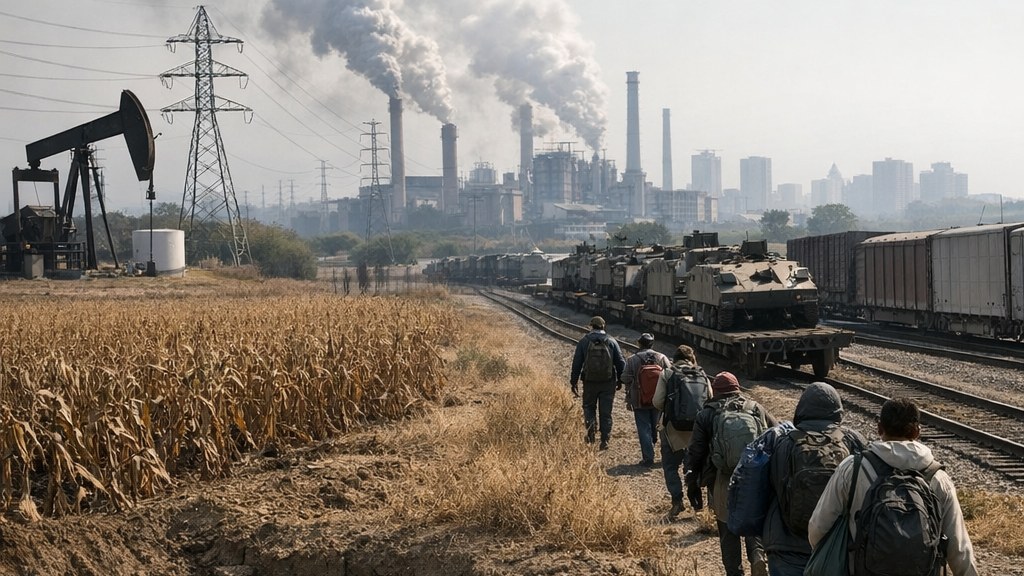
The world feels stable because many systems are still working. It is fragile because those systems are more connected, more expensive to defend and more exposed to politics, climate and technology shocks.
The main risk is not one dramatic failure. It is the accumulation of stress. A trade dispute can raise prices. A regional war can affect energy and food. A climate disaster can stretch public budgets. A cyberattack can interrupt services. Each problem is manageable alone. Together, they can test the whole system.
That is the central story of 2026. The world has not stopped. But the foundations under normal life are under strain.
AI Perspective
The useful lesson is that stability should not be judged only by whether daily life looks normal. Strong systems can keep working while their risks increase quietly. The safer path is to treat resilience as an active task, not as something the world automatically has.


-134c72da.webp)


-6c40e5ef.webp)

-1d29b0b2.webp)
-2721737f.webp)
-55bf1fe2.webp)
-9f154954.webp)