[[[SUMMARY_START]]]
Internet access has expanded across the world, but a new gap is becoming clearer.
For many connected people, the challenge is no longer getting online. It is managing time, focus, and constant digital pressure.
Schools, regulators, parents, and technology companies are now being pushed to respond.
[[[SUMMARY_END]]]
The digital divide once meant a simple question: who could get online and who could not. That gap still matters, especially in poorer regions and rural communities. But in many connected societies, a second divide is growing. It separates people who can control their digital attention from those whose days are shaped by alerts, feeds, short videos, games, and automated recommendations.
## Access has improved, but it is not the whole storyGlobal internet access has grown sharply over the past two decades. Recent global estimates put the number of internet users at about 6 billion people, or nearly three-quarters of the world’s population. About 2.2 billion people still remain offline, so the old access gap has not disappeared.
But in countries where smartphones and broadband are common, the problem is changing. Having a device is no longer enough. The more important question is whether people can use technology in ways that help them learn, work, rest, and connect without being constantly pulled away.
This is the attention divide. It is not measured only by cables, data plans, or devices. It is measured by quiet time, sleep, reading, classroom focus, family life, and the ability to finish a task without interruption.
## Young people show the shift most clearly
Teenagers are at the center of this change because they have grown up with smartphones, social platforms, video apps, messaging services, games, and now AI chatbots. Recent U.S. survey data shows that nearly all teens go online every day, and about four in ten say they are online almost constantly.
Smartphone access among teens is now near universal in the United States. That has brought real benefits. Young people use phones to talk with friends, find information, create videos, follow hobbies, listen to music, and get help with schoolwork.
The same devices also bring a steady stream of claims on attention. One study of young people’s phone use found that more than half of participants received at least 237 notifications a day. Many of those alerts came during school hours.
The result is a mixed digital life. A teen may have access to more knowledge than any earlier generation, but may also face more competition for every spare minute of focus.
## Schools are becoming the testing ground
Classrooms have become one of the clearest places where the attention divide is being debated. Digital tools can help teachers explain ideas, support students with disabilities, and give access to materials that were once hard to reach.
At the same time, phones can interrupt lessons even when they are not being used for schoolwork. International student testing data has linked digital distraction in class with weaker learning outcomes. The issue is not only one student looking at a screen. Other students can also be distracted by nearby device use.
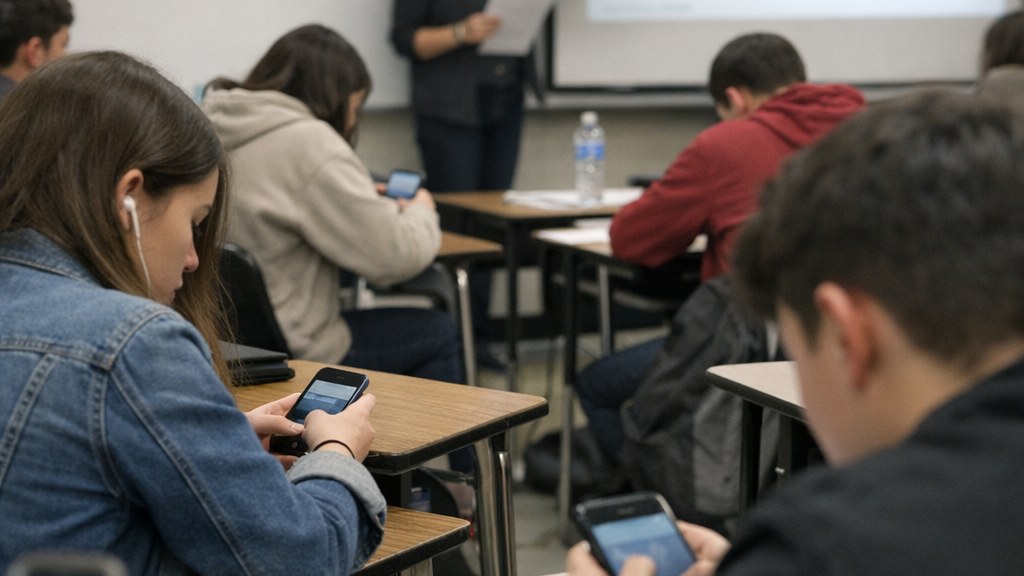
The debate remains practical. Schools still need technology for research, assignments, accessibility, and communication. The challenge is to separate useful digital learning from constant interruption.
## Platforms compete for time
The attention divide is also shaped by product design. Many digital services are built around feeds, autoplay, recommendations, streaks, alerts, and infinite scrolling. These tools can make services easier and more enjoyable to use. They can also make it harder to stop.
Regulators have begun to look more closely at these designs, especially when children are involved. European officials have examined whether features such as infinite scroll, autoplay, push notifications, and personalized recommendation systems create risks for minors. In the United States and other countries, lawmakers have also pressed for stronger child safety rules online.
AI adds another layer. Recent teen survey data shows that a majority of U.S. teens have tried AI chatbots, and about three in ten use them daily. Chatbots can help with studying, writing practice, and curiosity. They can also become another always-available digital channel competing for attention.
## The next divide may be about choice
The old digital divide asked whether people had access to the internet. The new divide asks whether people have meaningful control once they are online.
Families with more time, money, and digital knowledge may be better able to set limits, choose safer tools, pay for ad-free services, or create phone-free spaces. Schools with stronger support may be better able to teach digital habits, enforce rules, and use technology with purpose.
People with less support may face the heaviest burden. They may rely on one smartphone for work, school, banking, health care, entertainment, and social contact. They may have fewer quiet places to study or fewer adults available to help manage online life.
That means attention is becoming a resource. Like broadband, it can be unevenly distributed. Protecting it may become one of the next major tasks for education, public policy, and technology design.
AI Perspective
The attention divide does not mean technology is bad. It means access alone is no longer a full measure of digital fairness. The next step is helping people use powerful tools without losing control of their time and focus.


-134c72da.webp)


