[[[SUMMARY_START]]]
Automation is moving into daily life in quiet ways, often without a clear button or visible machine.
Smart meters, AI assistants, checkout systems, home devices and logistics robots now handle more routine tasks in the background.
The shift is bringing convenience, but it is also raising questions about control, trust, privacy and accountability.
[[[SUMMARY_END]]]
Invisible automation is becoming one of the defining technology shifts of everyday life in 2026. It is not always a robot on a factory floor or a chatbot on a screen. More often, it is a system that adjusts, predicts, sorts, pays, routes or monitors in the background while people go about ordinary tasks.
## Automation That Fades Into the BackgroundFor many people, automation now starts before they notice it. A phone unlocks with a face scan. A map app changes a route before a driver asks. A thermostat cuts energy use while a family is asleep. A bank blocks a suspicious card transaction in seconds. A delivery app updates an arrival time as traffic changes.
This is the new shape of automation. It is less visible than earlier waves of machines. It often works through software, sensors and connected services. Its main sign is not movement, but a decision made faster than a person could make it.
The numbers show how common this has become. In the United States, electric utilities had more than 140 million advanced smart meters in 2024, out of about 168 million total electric meters. These devices allow two-way communication between homes, businesses and power providers. They can support automated readings, outage detection and demand management.
Smart home technology is also becoming broader. Recent updates to the Matter smart home standard added support for cameras, closures, soil sensors and energy management features. The goal is to make devices from different companies work together more easily. That matters because many homes now contain a mix of connected speakers, locks, lights, cameras, appliances and thermostats.
## AI Moves From Tool to Helper
Artificial intelligence has made invisible automation more personal. Many people still think of AI as a chat window. But its wider role is often hidden inside search, email, customer service, fraud detection, language translation, photo sorting and workplace software.
A 2025 national survey found that 62 percent of U.S. adults said they interacted with AI at least several times a week. About 73 percent said they would be willing to let AI assist at least a little with day-to-day activities. At the same time, most adults said they wanted more control over how AI is used in their lives.
Workplaces show a similar pattern. By late 2025, 26 percent of U.S. employees were using AI at work at least a few times a week, while 12 percent used it daily. Use was highest in technology, finance, higher education and professional services. It was lower in retail, manufacturing and health care, where many jobs are less desk-based.
The next step is agentic automation. These systems do not only suggest an answer. They can take actions within limits set by a user or organization. In commerce, payment companies and technology platforms are testing ways for AI agents to search, compare and complete purchases. In June 2026, Visa moved to connect its payment network with ChatGPT so users could link cards and allow AI-assisted shopping at participating merchants.
This remains early. Questions remain about mistakes, refunds, fraud, consent and merchant acceptance. Still, the direction is clear: more routine online tasks are being designed so software can complete them with less direct human effort.
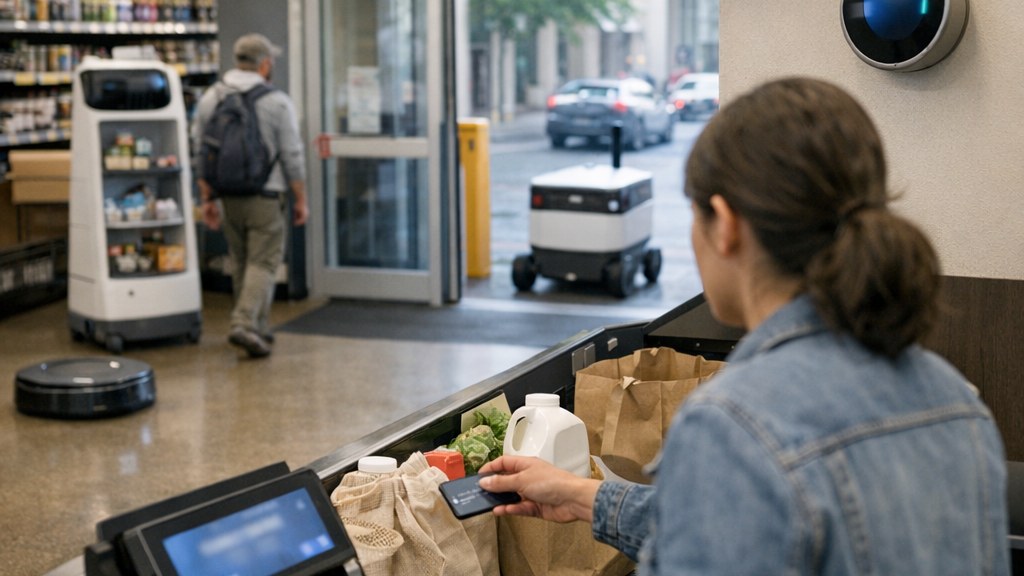
Physical robots are also spreading, though many are not seen by the public. Service robot sales for professional use reached almost 200,000 units in 2024, up 9 percent. Transportation and logistics made up more than half of that market, with about 102,900 units sold.
These robots often move goods in warehouses, hospitals, factories and distribution centers. They are not always humanoid. Many are mobile carts, cleaning machines, inventory systems or delivery units. Their value is in doing repetitive tasks consistently.
Consumer robots are more familiar. Nearly 20 million consumer service robots were sold in 2024 in the sample tracked by the global robotics industry. Domestic task robots, such as floor-cleaning and lawn-mowing machines, made up the largest group.
Medical robots are growing from a smaller base. Sales rose sharply in 2024, with demand in surgery, rehabilitation, diagnostics and laboratory automation. In those settings, automation is less about replacing care and more about handling precise or repetitive tasks under professional supervision.
## Convenience Brings New Questions
Invisible automation is popular because it reduces friction. It can save time, lower some costs and help systems respond faster. It can also improve accessibility for people who need help with reminders, navigation, translation or home control.
But invisibility creates a challenge. When a system works quietly, users may not know when a decision has been made, what data was used or how to correct an error. A rejected payment, a changed price, a delayed delivery or a flagged account can feel confusing if the automated process is not clear.
That is why trust is becoming as important as speed. The next stage of automation will depend not only on what systems can do, but on how clearly they explain limits, ask for permission and let people override decisions.
Invisible automation is no longer a future idea. It is already in meters, phones, stores, cars, homes, offices and hospitals. The main change in 2026 is that it is becoming more connected, more capable and harder to separate from ordinary life.
AI Perspective
The rise of invisible automation shows that the biggest technology changes are not always loud or obvious. The useful systems will be the ones that make daily life easier while keeping people informed and in control. The central question is not whether automation will spread, but how clearly it will serve human choices.


-134c72da.webp)


