[[[SUMMARY_START]]]
Workplaces, apps and digital platforms are measuring more of daily life than ever before.
The push for higher output can help people work faster, but it can also raise stress and weaken trust.
Recent surveys show a mixed picture: many workers see gains from AI, while many also report fatigue, surveillance and uncertainty.
[[[SUMMARY_END]]]
A growing part of modern life now runs on measurement. Work tasks are tracked. Messages are timed. Fitness, sleep, spending and attention are turned into scores. The goal is often simple: do more, waste less and improve constantly. But the human cost of living inside permanent optimization is becoming harder to ignore.
## A life measured in small signalsPermanent optimization is not one system. It is a condition shaped by many tools at once. In the workplace, it can mean AI assistants, productivity dashboards, keystroke trackers, meeting analytics and performance targets. Outside work, it can mean health apps, learning platforms, financial alerts and social feeds that reward constant activity.
Some of these tools are useful. They can remove routine tasks, help workers find information faster and support safer operations in fields such as logistics, health care and manufacturing. In early 2026, about two-thirds of employees in organizations using AI said it had a positive effect on productivity and efficiency. U.S. workplace AI use has also risen quickly, with about half of employed adults saying they had used AI at work by the first quarter of 2026.
The concern is not measurement itself. The concern is what happens when measurement becomes continuous and when every gap, delay or quiet moment looks like a problem to be corrected.
## Workdays with no clear edge
For many knowledge workers, the workday has become fragmented. Aggregated workplace data from 2025 showed heavy users receiving hundreds of pings in a day from emails, chats, meeting invitations and other tools. Messages outside the traditional 9-to-5 day also increased, and late meetings became more common as teams worked across time zones.
This does not mean every worker is online all day. But it shows how easily digital work can stretch beyond fixed hours. A person may be answering messages before breakfast, editing slides before a meeting, joining an evening call and catching up again after dinner.
The result is a feeling that work is never fully done. That feeling matters. Global employee engagement fell to 20% in 2025, while 40% of employees worldwide said they had experienced a lot of stress the previous day. Daily loneliness, sadness and anger also remained above pre-pandemic levels.
## The surveillance problem
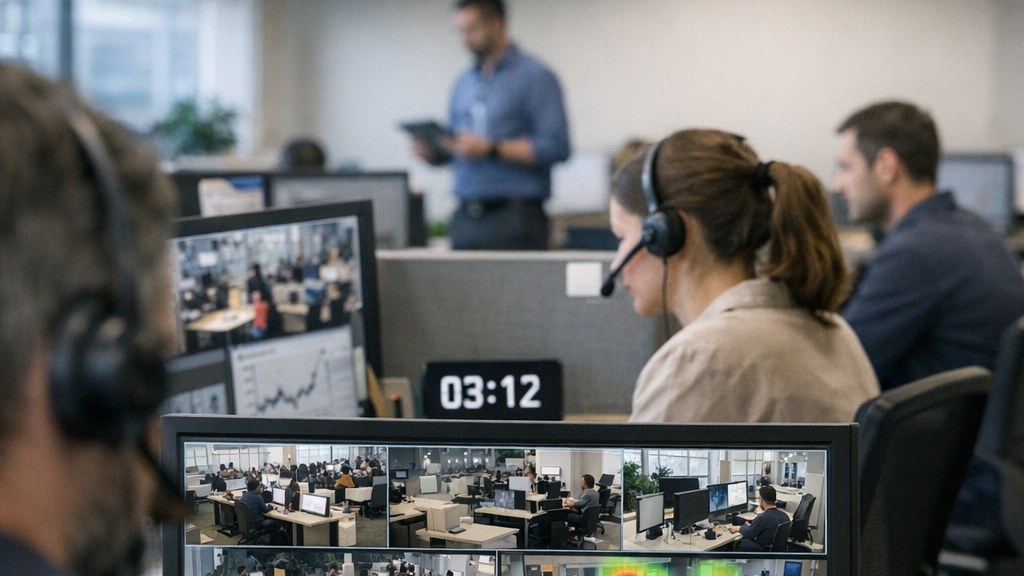
Monitoring is one of the sharpest points in the optimization debate. A 2025 global survey of nearly 38,000 workers in 34 markets found that almost one-third felt constantly watched at work. Workers who felt watched were far less likely to report high productivity and were more likely to report daily negative stress.
The issue is especially sensitive because some monitored activity is not the same as useful work. A salesperson may spend time thinking before writing to a client. A nurse may pause to assess a patient. A software engineer may solve a problem while away from the keyboard. Simple metrics can miss this kind of effort.
## AI brings gains, but also pressure
AI is now part of the same pattern. Many employees use it to summarize information, generate ideas, draft text or automate basic tasks. In those cases, it can save time and reduce repetitive work.
But AI can also raise expectations. If a tool helps one person finish faster, managers may expect the same person to handle more. The saved time may become new work instead of rest, learning or better service. Employees may also worry that using AI makes their own skills look less valuable, while not using it may make them look slow.
This is why the debate is moving from productivity alone to governance, trust and human oversight. In Europe, new platform-work rules require human oversight for important decisions affecting platform workers and limit purely automated dismissal. Other policy discussions are focusing on transparency, data rights and the use of algorithmic management inside ordinary workplaces.
## The limits of constant improvement
The central lesson is not that optimization should stop. Hospitals, transport networks, factories and offices all need good data. Better systems can reduce waste and prevent mistakes.
The risk comes when human beings are treated like systems that can be tuned without limits. People need recovery, privacy, trust and time for judgment. They also need room to learn and make decisions that cannot always be captured in a dashboard.
Employers that use AI and monitoring tools face a practical choice. They can use data to support people, improve staffing and clarify priorities. Or they can use it to tighten control and raise targets without changing the workload. The first path may improve work. The second may deepen burnout and turnover.
The age of permanent optimization is not only a technology story. It is a social question about what counts as good work, good health and a good day.
AI Perspective
The most useful technology should give people more room to think, not less. Optimization becomes harmful when it turns every moment into a performance test. The next stage of digital work will depend on whether organizations measure people with care, context and limits.


-134c72da.webp)


