[[[SUMMARY_START]]]
Cities are increasingly being used to test new ideas in transport, climate resilience, housing, data systems and public services.
Their density makes problems visible faster, but it also allows solutions to be tested at real scale.
From heat sensors in Boston to digital planning tools in Singapore and climate-neutral pilots in Europe, urban areas are shaping how future systems may work.
[[[SUMMARY_END]]]
Cities are no longer just places where people live and work. They are becoming active testing grounds for the next generation of public services, climate tools, transport systems and digital infrastructure.
## A world moving into citiesThe shift is being driven by scale. United Nations population projections show that about 58% of the world’s people live in urban areas in 2025. That share is expected to rise to about 67% by 2050.
This means many of the world’s biggest challenges are becoming urban challenges. Heat, flooding, traffic, housing pressure, air quality, waste, energy demand and digital access are now felt most sharply in cities.
Cities also offer something that laboratories cannot easily provide: real streets, real buildings and real daily routines. A new bus route, cooling system, sensor network or housing policy can be tested with immediate feedback from residents, workers and businesses.
## Climate pressure is speeding up experiments
Climate change is one of the strongest reasons cities are acting like test labs. Urban areas concentrate concrete, asphalt, vehicles and buildings. This can make heat worse and raise energy use.
In Boston, a heat sensor pilot called B-COOL installed 15 sensors at partner sites and on city-owned trees. The project focused on neighborhoods identified in the city’s heat plan. Early results showed that some hot spot areas can be 10 to 15 degrees warmer than surrounding neighborhoods.
That kind of local data can change how cities respond. It can help officials decide where to plant trees, open cooling centers, redesign streets or issue more targeted heat warnings.
Other cities are testing flood and stormwater systems. In Shanghai’s Lingang area, the Starry Sky Sponge Park combines public space with flood management infrastructure. It uses permeable surfaces, underground filtration and smart drainage to absorb and reuse rainwater. Such projects show how parks can also act as climate infrastructure.
## Transport is moving from trial to street
Mobility is another major testing area. Autonomous vehicles, electric buses, bike lanes, curbside delivery zones and traffic sensors are all being tried in dense urban settings.
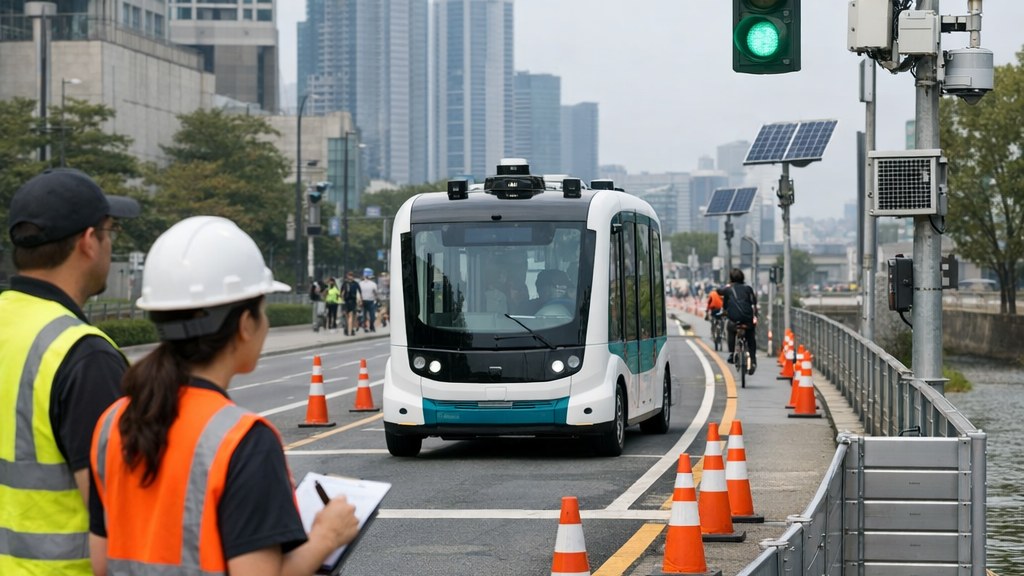
Robotaxis show how cities can shape the pace of new technology. In 2025, Waymo vehicles were operating in several U.S. cities, including Phoenix, San Francisco, Los Angeles, Austin and Atlanta. New York City also allowed a limited pilot in Manhattan and downtown Brooklyn, with up to eight autonomous vehicles, safety operators behind the wheel and no passenger pickups under local rules.
These pilots are not just technology tests. They are also governance tests. Cities must decide where vehicles can operate, what safety rules apply, how data is handled and how new services fit with public transit, pedestrians and cyclists.
Some cities are also building digital versions of themselves. These tools, often called digital twins, allow planners to simulate changes before they are built.
Singapore has become one of the most cited examples. Its Smart Nation work includes tools for real-time urban management, micro-climate simulation and smart water metering. In the Punggol Digital District, an Open Digital Platform is designed to integrate systems such as cooling, security, parking and other district operations.
The value of these systems is practical. A planner can test how a new building may affect wind, sunlight, noise or temperature. A water agency can monitor usage. A district manager can see how different systems interact.
But digital tools also raise questions. Cities need rules for privacy, cybersecurity, accountability and public access. A sensor network may improve services, but it can also create concern if residents do not know what data is collected or how it is used.
## Europe’s city mission shows the scale of the shift
The European Union’s Climate-Neutral and Smart Cities Mission shows how formal this urban testing model has become. The program supports 112 cities working toward climate neutrality by 2030. The goal is not only to cut emissions in those cities, but also to make them experimentation and innovation hubs for others.
The mission links local governments with residents, companies, investors and regional bodies. Its focus covers energy, buildings, waste, transport and investment planning.
This approach reflects a broader change in urban policy. Cities are not waiting for perfect national systems before acting. They are testing smaller projects, learning from results and scaling what works.
## The limits of the city lab
The test-lab model has limits. A pilot project can help one district but fail to reach poorer neighborhoods. A smart service can improve convenience for connected residents while leaving others behind. A climate tool can produce useful data but still need money, maintenance and political support.
That is why many urban policy groups now emphasize people-centered smart cities. Technology is most useful when it solves clear public problems and when residents have a role in shaping it.
The future being tested in cities is not only about machines, sensors or artificial intelligence. It is also about trust, fairness and the basic design of daily life.
AI Perspective
Cities are becoming test labs because the problems are immediate and the feedback is fast. The strongest urban experiments are likely to be the ones that improve daily life in clear ways, not just the ones that use the newest technology. The central question is whether innovation can be made useful, fair and understandable for the people who live with it every day.


-134c72da.webp)


